PASSAGES: THE ROBBER BARONS -Part 2
Excerpts from History of the Great American Fortunes by Gustavus Myers (1907)

My goodness gracious, this is a long book!
It’s just over 700 pages, and I skipped the last 65.
Part 1 of this post shared about 45 pages worth, and Part 2 will now share about 80 pages worth.
That saves you a lot of reading!
Most Substack posts are about 2 to 3,000 words, and this Part 2 is about 42,000. Yikes.
Please know that all of the excerpts are largely stand-alone in concept. You can read a little bit, then leave it, then come back, with no harm done.
Here are some of the repeated themes:
>The bigshots getting free money and/or land from state and federal congresses.
>Stock watering (usually railroads) to swindle public stock market investors.
>The criminal neglect of railroad and workplace safety guidelines, resulting in injury and death.
>The bigshots being treated with kid gloves by the legal system for such affronts and thence being portrayed as magnates and philanthropists (by the mainstream news, yeah?).
>The grinding poverty of the common man (think of The Jungle by Upton Sinclair).
>The ongoing pecking order: The middle class (small businesses) complaining about the incursions of the bigshots (the Robber Barons), all the while preying upon the common citizen in the most grotesque manner.
NARRATIVE TIMELINE
The second 2/3 of the book tends to have an intertwining timeline because the major characters’ lifetimes overlap – it’s not strictly linear. We're dealing in essence with the “Robber Baron Era” ─ roughly from the Civil War to just past the turn of the Century.
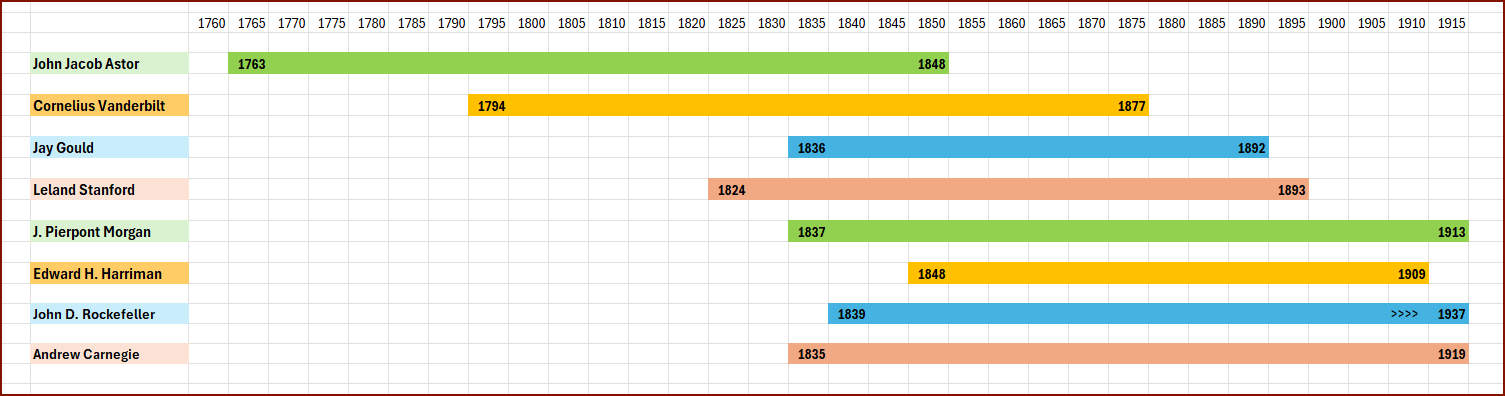
(click to enlarge)
The first five characters shown above are discussed at length in the book. The least known today is Jay Gould because he never tried to prettify his reputation by pretending to be a philanthropist (steal a million, give back a hundred).
The last three are mentioned in passing. We all understand that Rockefeller alone could require three additional 700-page books, and anyway his grandest accomplishments occurred later than the time frame of this work.
Harriman is mentioned the most often, but his lasting significance in the arc of history lies with his son, Averell. This son exemplifies the intersect between massive wealth and extensive influence in national politics and policy ─ indeed, in international policy. I offer you the following document: miscellaneous citations of Averell Harriman from my archives, to further show what I mean.

Subscribing to LIAR$$WORLD is free, hoping that you will pay-subscribe to other Substackers who have more expenses and post more often.
Rockefeller and Carnegie are legendary as philanthropists, to the naïve, and even more legendary as pioneers in social engineering, to the savvy (you, my readers).
As you know, social engineering is ALWAYS EVIL, and these two monsters were grade A manipulators.
We might visualize that the story at hand is about US-CABAL 1.0, the progenitors; and a book about the Rockefeller grandsons and Averell would be classed as US-CABAL 2.0, the full interpenetration … the public/private “partnership” dynamic. The magnates have become ever more organized and scientific in their machinations.
GUSTAVUS MEYERS
I love this man, and I love his erudite writing – kind of a Dickens for conspiracy theorists!
My excerpting is by no means scientific. Although usually for the explication of immoral commercial behaviors, another reason for inclusion is for the sheer stimulation of Gustavus’ command of the language, and ability to whack you upside the head with subtlety! His talent for sarcasm stabs deeply and leaves no room for dissimulation on the target’s part.
<>
My comments are minimal. Those pertaining to a preceding section will start with (<<) and those about a following section will start with (>>). Pages numbers appear at the END of each excerpt.
The traditional bracketing of quoted sections is reversed, meaning my words are bracketed, since they are in the minority.
The book first appeared in 1907, with a final update in 1936.

Part 1 ended with Vanderbilt being outfoxed by Gould, but there is still quite a bit of material about Vanderbilt before we shift over to Gould’s story.
Prior to this next section was a description of the famous stock watering intrigues in the railroad companies, along with further swindles, with the government paying for capital improvements and foregoing taxation of the railroad magnates and so on. This criminal “format” is found throughout the book.
(>>) The following long section is admitted by Myers to be philosophical in character, and such passages appeal to me the most because I need someone to explain the import of the societal dynamics of the day, and how these dynamics relate to the present time. The time period is roughly soon after the Civil War.
Everywhere was fraud; even the little storekeepers, with their smug pretensions to homely honesty, were profiting by some of the vilest, basest forms of fraud, such as robbing the poor by the light-weight and short-weight trick, of (far worse) by selling skim milk, or poisonous drugs or adulterated food or shoddy material. These practices were so prevalent, that the exceptions were rarities indeed.
If any administration had dared seriously to stop these forms of theft the trading classes would have resisted and struck back in political action. Yet these were the men—these traders—who vociferously came forth with their homiletic tirades against Vanderbilts criminal transactions, demanding that the power of him and his kind be curbed.
It was not at all singular that they put their protests on moral grounds. In a form of society where each man is compelled to fight every other man in a wild, demoralizing struggle for self-preservation, self- interest naturally usurps the supreme functions, and this self-interest becomes transposed, by a comprehensible process, into moralities. That which is profitable is perverted into a moral code; the laws passed, the customs introduced and persisted in, and the weight of the dominant classes all conspire to put the stamp of morality on practices arising from the lowest and most sordid aims. Thus did the trading class make a moral profession of its methods of exploitation; it congratulated and sanctified itself on its purity of life and its saving stability.
From this class—a class interpenetrated in every direction with commercial frauds—was largely empanelled the men who sat on those grand juries and petit juries solemnly passing verdict on the poor wretches of criminals whom environment or poverty had driven into crime. They were the arbiters of justice, but it was a justice that was never allowed to act against themselves. Examine all the penal codes of the period; note the laws proscribing long sentences in prison for thefts of property; the larceny of even a suit of clothes was severely punishable, and begging for alms was a misdemeanor. Then contrast these asperities of law with the entire absence of adequate protection for the buyer of merchandise. Following the old dictum of Roman jurisprudence, “Let the buyer beware,’’ the factory owner could at will oppress his workers, and compel them, for the scantiest wages, to make for his profit goods unfit for consumption. These articles the retailer sold without scruple over his counter; when the buyer was cheated or overcharged, as happened with great frequency, he had practically no redress in law. If the merchant were robbed of even ever so little he could retaliate by sending the guilty one to prison. But the merchant himself could invidiously and continuously rob the customer without fear of any law. All of this was converted into a code of moralities; and any bold spirit who exposed its cant and sham was denounced as an agitator and as an enemy of law and order.
Vanderbilt did better than expose it; he improved upon, and enlarged it and made it a thing of magnitude; he and others of his quality discarded petty larceny and ascended into a sphere of superlative grand larceny. They knew with a cynical perception that society, with all its pompous pretensions to morality, had evolved a rule which worked with almost mathematical certainty. This rule was the paradoxical, but nevertheless true, one that the greater the theft the less corresponding danger there was of punishment.
THE WISDOM OF GRAND LARCENY
Now it was that one could see with greater clearness than ever before, how the mercenary ideal of the ruling class was working out to its inevitable conclusion. Society had made money its god and property its yardstick; even in its administration of justice, theoretically supposed to be equal, it had made “justice” an expensive luxury available, in actual practice, to the rich only. The defrauder of large sums could, if prosecuted, use a part of that plunder, easily engage a corps of shrewd, experienced lawyers, get evidence manufactured, fight out the case on technicalities, drag it along for years, call in political and social influence, and almost invariably escape in the end.
But beyond this power of money to make a mockery of justice was a still greater, though more subtle, factor, which was ever an invaluable aid to the great thief. Every section of the trading class was permeated with a profound admiration, often tangibly expressed, for the craft that got away with an impressive pile of loot. The contempt felt for the pickpocket was the antithesis of the general mercantile admiring view of the man who stole in grand style, especially when he was one of their own class. In speaking of the piratical operations of this or that magnate, it was common to hear many business men interject, even while denouncing him, “Well, I wish I were as smart as he.” These same men, when serving on juries, were harsh in their verdicts on poor criminals, and unctuously flattered themselves with being, and were represented as, the upholders and conservers of law and moral conduct.
Departing from the main facts as this philosophical digression may seem, it is essential for a number of reasons. One of these is the continual necessity for keeping in mind a clear, balanced perspective. Another lies in the need of presenting aright the conditions in which Vanderbilt and magnates of his type were produced. Their methods at basis were not a growth independent of those of the business world and isolated from them. They were simply a development, and not merely one of standards as applied to morals, but of the mechanism of the social and industrial organization itself. Finally it is advisable to give flashlight glimpses into the modes and views of the time, inasmuch as it was in Vanderbilt’s day that the great struggle between the old principle of competition, as upheld by the small capitalists, and the superseding one of consolidation, as incarnated in him and others, took on vigorous headway.
HE CONTINUES THE BUYING OF LAWS
Protest as it did against Vanderbilt’s merging of railroads, the middle class found itself quite helpless. In rapid succession he put through one combination after another, and caused theft after theft to be legalized, utterly disdainful of criticism or opposition. In State after State he bought the repeal of old laws, or the passage of new laws, until he was vested with authority to connect various railroads that he had secured between Buffalo and Chicago, into one line with nearly 1,300 miles of road. The commercial classes were scared at the sight of such a great stretch of railroad—then considered an immense line—in the hands of one man, audacious, all-conquering, with power to enforce tribute at will. Again Vanderbilt patronized the printing presses, and many more millions of stock, all fictitious capital, were added to the already flooded capital of the Lake Shore and Michigan Southern Railroad Company. Of the total of $62,000,000 of capital stock in 1871, fully one-half was based upon nothing but the certainty of making it valuable as a dividend payer by the exaction of high freight and passenger rates. A little later, the amount was run up to $73,000,000, and this was increased subsequently.
Vanderbilt now had a complete railroad system from New York to Chicago, with extensive offshoots. It is at this point that we have to deal with a singular commendation of his methods thrust forward glibly from that day to this. True, his eulogists admitted then, as they admit now, Vanderbilt was not overscrupulous in getting property that he wanted. But consider, they urge, the improvements he brought about on the railroads that came into his possession; the renovation of the roadbed, the institution of new locomotives and cars, the tearing down of the old, worn-out stations. This has been the praise showered upon him and his methods.
Inquiry, however, reveals that this appealing picture, like all others of its sort, has been ingeniously distorted. The fact was, in the first place, that these improvements were not made out of regard to public convenience, but for two radically different reasons. The first consideration was that if the dividends were to be paid on the huge amount of fabricated stock, the road, of necessity, had to be put into a condition of fair efficiency to meet or surpass the competing facilities of other railroads running to Chicago. Second, the number of damage claims for accident or loss of life arising largely from improper appliances and insufficient safeguards, was so great that it was held cheaper in the long run to spend millions for improvements.
PUBLIC FUNDS FOR PRIVATE USE
Instead of paying for these improvements with even a few millions of the proceeds of the watered stock, Vanderbilt (and all other railroad magnates in like cases did the same) forced the public treasury to defray a large part of the cost.
Pages 314-318
At the very time that he was watering stock, sliding through legislatures corrupt grants of perpetual franchises, and swindling cities and States out of huge sums in taxes, Vanderbilt was forcing the drivers and conductors on the Fourth avenue surface line to work an average of fifteen hours out of twenty-four, and reducing their daily wages from $2.25 to $2.00.
Vanderbilt made the pretense that it was necessary to economize; and, as was the invariable rule of the capitalists, the entire burden of the economizing process was thrown upon the already overloaded workers. This subtraction of twenty-five cents a day entailed upon the drivers and conductors and their families many severe deprivations; working for such low wages every cent obviously counted in the management of household affairs. But the methods of the capitalist class in deliberately pyramiding its profits upon the sufferings of the working class were evidenced in this case (as they had been, and since have been, in countless other instances) by the announcement in the Wall street reports that this reduction in wages was followed by an instant rise in the price of the stock of the Fourth avenue surface line. The lower the wages, the greater the dividends.
Page 322
VANDERBILT’S CHIEF OF STAFF
His chief instrument during all those years was a general utility lawyer, Chauncey M. Depew, whose specialty was to impress the public by grandiloquent exhibitions of mellifluent spread-eagle oratory, while bringing the “proper arguments” to bear upon legislators and other public officials. Every one who could in any way be used, or whose influence required subsidizing, was, in the phrase of the day, “taken care of.” Great sums of money were distributed outright in bribes in the legislatures by lobbyists in Vanderbilt’s pay. Supplementing this, an even more insidious system of bribery was carried on. Free passes for railroad travel were lavishly distributed; no politician was ever refused; newspaper and magazine editors, writers and reporters were always supplied with free transportation for the asking, thus insuring to a great measure their good will, and putting them under obligations not to criticize or expose plundering schemes or individuals. All railroad companies used this form, as well as other forms, of bribery.
It was mainly by means of the free pass system (which was not abolished by Congressional legislation until 1906) that Depew, acting for the Vanderbilts, secured not only a general immunity from newspaper criticism, but continued to have himself and them portrayed in luridly favorable lights. Depending upon the newspapers for its sources of information, the public was constantly deceived and blinded, either by the suppression of certain news, or by its being tampered with and grossly colored. This Depew continued as the representative of the Vanderbilt family for nearly half a century.
(skip a short portion)
The career of Depew is of no interest to posterity, excepting in so far as it shows anew how the magnates were able to use intermediaries to do their underground work for them, and to put those intermediaries into the highest official positions in the country. This fact alone was responsible for their elevation to such bodies as the United States Senate, the President’s Cabinet and the courts. Their long service as lobbyists or as retainers was the surest passport to high political or judicial position; their express duty was to vote or decide as their masters’ interest bid them. So it was that men who put their cunning or brains at the complete disposal of the magnates, filled Congress and the courts. These were, to a large extent, the officials by whose votes or decisions all measures of value to the working class were defeated; and reversely, by whose actions all or nearly all bills demanded by the money interests, were passed and sustained.
After having bribed legislatures to legalize his enormous issue of watered stock, what was Vanderbilt’s next move? The usual fraudulent one of securing exemption from taxation. He and other railroad owners sneaked through law after law by which many of their issues of stock were made non-taxable.
So now old shaggy Vanderbilt loomed up the richest magnate in the United States. His ambition was consummated; what mattered it to him that his fortune was begot in blackmail and extortion, bribery and theft? Now that he had his hundred millions he had the means to demand adulation and the semblance of respect, if not respect itself. The commercial world admired, even while it opposed him; in his methods it saw at bottom the abler application and extension of its own, and while it felt aggrieved at its own declining importance and power, it rendered homage in the awed, reverential manner in which it viewed his huge fortune.
Over and over again, even to the point of wearisome repetition, must it be shown, both for the sake of true historical understanding and in justice to the founders of the great fortunes, that all mercantile society was permeated with fraud and subsisted by fraud. But the prevalence of this fraud did not argue its practitioners to be inherently evil. They were victims of a system inexorably certain to arouse despicable qualities. The memorable difference between the two classes was that the workers, as the sufferers, were keenly alive to the abominations of the system, while the capitalists not only insisted upon the right to benefit from its continuance, but harshly sought to repress every attempt of the workers to agitate for its modification or overthrow.
Pages 323-324
(>>) A repeated theme in the book is how the small and mid-size captains of commerce, be it manufacturing or retail, routinely preyed upon the common man, yet were quite vocal when citing the swindles and thefts of the titans of commerce ─ the Vanderbilts, Goulds, Morgans, and Rockefellers. This section ends with Vanderbilt discovering “philanthropy” ─ a practice which Rockefeller perfected: steal a $$ million give back a $$ hundred.
These same manufacturers objected in the most indignant manner, as they similarly do now, to any legislative investigations of their own methods. Eager to have the practices of Vanderbilt and Gould probed into, they were acrimoniously opposed to even criticism of their factory system. For this extreme sensitiveness there was the amplest reason. The cruelties of the factory system transcended belief. In, for instance, the State of Massachusetts, vaunting itself for its progressiveness, enlightenment and culture, the textile factories were a horror beyond description. The Convention of the Boston Eight Hour League, in 1872, did not overstate when it declared of the factory system that “it employs tens of thousands of women and children eleven and twelve hours a day; owns or controls in its own selfish interest the pulpit and the press; prevents the operative classes from making themselves felt in behalf of less hours, through remorseless exercise of the power of discharge; and is rearing a population of children and youth of sickly appearance and scanty or utterly neglected schooling.”
As the factory system was in Massachusetts, so it was elsewhere. Any employee venturing to agitate for better conditions was instantly discharged; spies were at all times busy among the workers; and if a labor union were formed, the factory owners would obtain sneak emissaries into it, with orders to report on every move and disrupt the union if possible. The factory capitalists in Massachusetts, New York, Illinois and every other manufacturing State were determined to keep up their system unchanged, because it was profitable to work children eleven and a half hours a day in a temperature that in summer often reached 108 degrees and in an atmosphere certain to breed immorality; it was profitable to compel adult men and women having families to work for an average of ninety cents a day; it was profitable to avoid spending money in equipping factories with life-saving apparatus. Hence these factory owners, forming the aristocracy of trade, savagely fought every move or law that might expose or alter those conditions; the annals of legislative proceedings are full of evidences of bribery.
Having no illusions, and being a severely practical man, Vanderbilt well knew the pretensions of this trading class; with many a cynical remark, aptly epitomizing the point, he often made sport of their assumptions. He knew (and none knew better) that they had dived deep in bribery and fraud; they were the fine gentlemen, he well recalled, who had generally obtained patents by fraud; who had so often bribed members of Congress to vote for a high tariff; the same, too, who had bribed legislatures for charters, water rights, exemptions from taxation, the right to work employees as long as, and under whatever conditions, they wanted to. This manufacturing aristocracy professed to look down upon Vanderbilt socially as a coarse sharper; and in New York a certain ruling social element, the native aristocracy, composed of old families whose wealth, originating in fraud, had become respectable by age, took no pains to conceal their opinion of him as a parvenu, and drew about their sacred persons an amusing circle of exclusiveness into the rare precincts of which he might not enter.
Vanderbilt now proceeded to buy social and religious grace as he had bought laws. The purchase of absolution has ever been a convenient and cheap method of obtaining society’s condonation of theft. In medieval centuries it took a religious form; it has become transposed to a social traffic in these superior days. Let a man steal in colossal ways and then surrender a small part of it in charitable, religious and educational donations; he at once ceases being a thief and straightway becomes a noble benefactor. Vanderbilt now shed his life-long irreverence, and gave to Deems, a minister of the Presbyterian Church, as a gift, the Church of the Strangers on Mercer street, and he donated $1,000,000 for the founding of the Vanderbilt University at Nashville, Tenn. The press, the church and the educational world thereupon hailed him as a marvel of saintly charity and liberality.
Pages 325-327
CHAPTER VI
THE ENTAILING OF THE VANDERBILT FORTUNE
The richer Commodore Vanderbilt grew, the more closely he clung to his old habits of intense parsimony. Occasionally he might ostentatiously give a large sum here or there for some religious or philanthropic purpose, but his general undeviating course was a consistent meanness. In him was united the petty bargaining traits of the trading element and the lavish capacities for plundering of the magnate class. While defrauding on a great scale, pocketing tens of millions of dollars at a single raid, he would never for a moment overlook the leakage of a few cents or dollars. His comprehensive plans for self-aggrandizement were carried out in true piratical style; his aims and demands were for no paltry prize, but for the largest and richest booty. Yet so ingrained by long development was his facility of acquisition, that it far passed the line of a passion and became a monomania.
VANDERBILT’S CHARACTERISTICS
To such an extent did it corrode him that even when he could boast his $100,000,000 he still persisted in haggling and huckstering over every dollar, and in tricking his friends in the smallest and most underhand ways. Friends in the true sense of the word he had none; those who regarded themselves as such were of that thrifty, congealed disposition swayed largely by calculation. But if they expected to gain overmuch by their intimacy, they were generally vastly mistaken; nearly always, on the contrary, they found themselves caught in some unexpected snare, and riper in experience, but poorer in pocket, they were glad to retire prudently to a safe distance from the old man’s contact. ‘‘Friends or foes,” wrote an admirer immediately after his death, “were pretty much on the same level in his estimation, and if a friend undertook to get in his way he was obliged to look out for himself.”
On one occasion, it is related, when a candidate for a political office solicited a contribution, Vanderbilt gave $100 for himself, and an equal sum for a friend associated with him in the management of the New York Central Railroad. A few days later Vanderbilt informed this friend of the transaction, and made a demand for the hundred dollars. The money was paid over. Not long after this, the friend in question was likewise approached for a political contribution, whereupon he handed out $100 for himself and the same amount for Vanderbilt. On being told of his debt, Vanderbilt declined to pay it, closing the matter abruptly with this laconic pronunciamento, “When I give anything, I give it myself.” At another time Vanderbilt assured a friend that he would “carry” one thousand shares of New York Central stock for him. The market price rose to $115 a share and then dropped to $90. A little later, before setting out to bribe an important bill through the Legislature—a bill that Vanderbilt knew would greatly increase the value of the stock— the old magnate went to the friend, and represented that since the price of the stock had fallen it would not be right to subject the friend to a loss. Vanderbilt asked for the return of the stock and got it. Once the bill became a law, the market price of the stock went up tremendously, to the utter dismay of the confiding friend who saw a profit of $80,000 thus slip out of his hands into Vanderbilt’s.
In his personal expenses Vanderbilt usually begrudged what he looked upon as superfluous expense. The plainest of black clothes he wore, and he never countenanced jewelry. He scanned the table bill with a hypercritical eye. Even the sheer necessities of his physical condition could not induce him to pay out money for costly prescriptions. A few days before his death his physician recommended champagne for some internal trouble. “ChampagneI” exclaimed Vanderbilt with a reproachful look, “I can’t afford champagne. A bottle every morning! Oh, I guess sody water’ll do!”
Pages 331-332
Even as Vanderbilt lay moribund, speculation was busy as to the disposition of his fortune. Who would inherit his aggregation of wealth? The probating of his will soon disclosed that he had virtually entailed it. About $90,000,000 was left to his eldest son, William H., and one-half of the remaining $15,000,000 was bequeathed to the chief heir’s four sons. A few millions were distributed among the founder’s other surviving children, and some comparatively small sums bequeathed to charitable and educational institutions. The Vanderbilt dynasty had begun.
Pages 333-334
(<<) Cornelius “Commodore” Vanderbilt dies 1860.
Since his father's death he had added fully $100,000,000 to his wealth, all within a short period. It had taken Commodore Vanderbilt more than thirty years to establish the fortune of $105,000,000 he left. With a greater population and greater resources to prey upon, William H. Vanderbilt almost doubled the amount in seven years. In January, 1883, he confided to a friend that he was worth $194,000,000. “I am the richest man in the world,” he went on. “In England the Duke of Westminster is said to be worth $200,000,000, but it is mostly in land and houses and does not pay two per cent.” In the same breath that he boasted of his wealth he would bewail the ill-health condemning him to be a victim of insomnia and indigestion.
Having a clear income of $10,350,000 a year, he kept his ordinary expenses down to $200,000 a year. Whatever air of indifference he would assume in his grandee role of “art collector,” yet in most other matters he was inveterately close-fisted. He had a delusion that “everybody in the world was ready to take advantage of him,” and he regarded “men and women, as a rule, as a pretty bad lot.” This incident—one of many similar incidents narrated by Croffut—reveals his microscopic vigilance in detecting impositions:
When in active control of affairs at the office he followed the unwholesome habit of eating the midday lunch at his desk, the waiter bringing it in from a neighboring restaurant.
He paid his bill for this weekly, and he always scrutinized the items with proper care. “Was I here last Thursday?” he asked of a clerk at an adjoining desk.
“No, Mr. Vanderbilt; you stayed at home that day.”
“So I thought,” he said, and struck that day from the bill. Another time he would exclaim, sotto voce, “I didn’t order coffee last Tuesday,” and that item would vanish.
Pages 344-345
He had abundantly proved his autocracy. Law after law had he violated; like his father he had intimidated, had brought about the passage of laws he wanted, ignored such as were unsuited to his interests, and had decreed his own rules and codes. Progressively bolder had the money kings become in coming out into the open in the directing of Government. Long had they prudently skulked behind forms, devices and shams; they had operated secretly through tools in office, while virtuously disclaiming any insidious connection with politics. But no observer took this pretence seriously. James Bryce, fresh from England, delving into the complexities and incongruities of American politics at about this time, wrote that “these railway kings are among the greatest men, perhaps I may say, the greatest men in America,” which term, “greatest,” was a ludicrously reverent way of describing their qualities. “They have power,” he went on in the same work, “more power—that is, more opportunity to make their will prevail, than perhaps any one in political life except the President or the Speaker, who, after all, hold theirs only for four years and two years, while the railroad monarch holds his for life.” ® Bryce was not well enough acquainted with the windings and depths of American political workings to know that the money kings had more power than President or Speaker, not nominally, but essentially. He further related how when a railroad magnate traveled, his journey was like a royal progress; Governors of States and Territories bowed before him; Legislatures received him in solemn session; cities and towns sought to propitiate him, for had he not the means of making or marring a city’s fortunes? ‘^You cannot turn in any direction in American politics,” wrote Richard T. Ely a little later, ‘‘without discovering the railway power. It is the power behind the throne. It is a correct popular instinct which designates the leading men in the railways, railroad magnates or kings. ... Its power ramifies in every direction, its roots reaching counting rooms, editorial sanctums, schools and churches which it supports with a part of its revenues, as well as courts and Legislatures...”
(>>) William Vanderbilt’s death 1885 (eldest son of the “Commodore”)
HIS DEATH A NOTABLE EVENT
Vanderbilt’s death, as that of one of the real monarchs of the day, was an event of transcendent importance, and was treated so. The vocabulary was ransacked to find adjectives glowing enough to describe his enterprise, foresight, sagacity and integrity. Much elaborated upon was the fiction that he had increased his fortune by honest, legitimate means— a fiction still disseminated by those shallow or mercenary writers whose trade is to spread orthodox belief in existing conditions. The underlying facts of his career and methods were purposely suppressed, and a nauseating sort of panegyric substituted. The extent of his possessions and the size of his fortune aroused wonderment, but no effort was made to contrast the immense wealth bequeathed by one man with the dire poverty on every hand, nor to connect those two conditions.
At the very time his wealth was being inventoried at $200,000,000, not less than a million wage earners were out of employment, while the millions at work received the scantiest wages. Nearly three millions of people had been completely pauperized, and, in one way or another, had to be supported at public expense. Once in a rare while, some perceptive and unshackled public official might pierce the sophistries of the day and reveal the cause of this widespread poverty, as Ira Steward did in the fourth annual report of the Massachusetts Bureau of Statistics of Labor for 1873.
“It is the enormous profits,” he pointedly wrote, “made directly upon the labor of the wage classes, and indirectly through the results of their labor, that, first, keeps them poor, and, second, furnishes the capital that is finally loaned back to them again” at high rates of interest. Unquestionably sound and true was this explanation, yet of what avail was it if the causes of their poverty were withheld from the active knowledge of the mass of the wage workers? It was the special business of the newspapers, the magazines, the pulpit and the politicians to ignore, suppress or twist every particle of information that might enlighten or arouse the mass of people; if these agencies were so obtuse or recalcitrant as not to know their expected place and duty at critical times, they were quickly reminded of them by the propertied classes. To any newspaper owner, clergyman or politician showing a tendency to radicalism, the punishment came quickly. The newspaper owner was deprived of advertisements and accommodations, the clergyman was insidiously hounded out of his pulpit by his own church associations, the funds of which came from men of wealth, and the politician was ridiculed and was summarily retired to private life by corrupt means. As for genuinely honest administrative officials (as distinguished from the apparently honest) who exposed prevalent conditions and sought to remedy them in their particular departments, they were eventually got rid of by a similar campaign of calumny and corrupt influences.
Pages 345-347
(>>) New theme: labor organizing and protesting:
THE GREAT LABOR MOVEMENT OF 1886
Now, to the intense alarm of all sections of the capitalist class, a very different quality of movement reared itself upward from the deeps of the social formation.
This time it was the laboring masses preparing for the most vigorous and comprehensive attack that they had ever made upon capitalism’s intrenchments. Long exploited, oppressed and betrayed, starved or clubbed into intervals of apathy or submission, they were again in motion, moving forward with a set deliberation and determination which disconcerted the capitalist class. No mere local conflict of class interests was it on this occasion, but a general cohesive revolt of the workers against some of the conditions and laws under which they had to labor.
In 1884 the Federation of Trades and Labor Unions of the United States and Canada had issued a manifesto calling upon all trades to unite in the-demand for an eight-hour work day. The date for a general strike was finally fixed for May 1, 1886. The year 1886, therefore, was one of general agitation throughout the United States. With rapidity and enthusiasm the movement spread. Presently it took on a radical character. Realizing it to be at basis the first national awakening of the proletariat, progressive men and women of every shade of opinion hastened forward to support it and direct it into one of opposition, not merely to a few of the evils of wage slavery, but to what they considered the fundamental cause itself—the capitalist system.
The propertied classes were not deceived. They knew that while this labor movement nominally confined itself to one for a shorter work day, yet its impetus was such that it contained the fullest potentialities for developing into a mighty uprising against the very system by which they were enabled to enrich themselves and enslave the masses.
The moment this fact was discerned, both great and small capitalists instinctively suspended hostilities. They tacitly agreed to hold their bitter warfare for supremacy in abeyance, and unite in the face of their common danger. The triangular conflict between the large and small capitalists and the trades unions now resolved into a duel between the propertied classes of all descriptions on the one hand, and, on the other, the workingmen’s organizations. The Farmers’ Alliance, essentially a middle-class movement of the employing farmers in the South and West, was counted upon as aligned with the propertied classes. On the part of the capitalists there was no unity of organization in the sense of selected leaders or committees. It was not necessary. A stronger bond than that of formal organization drove them into acting in conscious unison—namely, the immediate peril involved to their property interests. Apprehension soon gave way to grim decision. This formidable labor movement had to be broken and dispersed at any cost.
But how was the work of destruction to be done? This was the predicament. Vested wealth could succeed in bribing a labor leader here and there; but the movement had bounded far beyond the elemental stage, and had become a glowing agitation which no traitor or set of traitors could have stopped.
One effective way of discrediting and suppressing it there was; the ancient one of virtually outlawing it, and throwing against it the whole brute force of Government. The task of putting it down was preeminently One for the police, army and judiciary. They had been used to stifle many another protest of the workers; why not this? As the great labor movement rolled on, enlisting the ardent attachment of the masses, denouncing the injustices, corruption and robberies of the existing industrial system, the propertied classes more acutely understood that they must hasten to stamp it out by whatever means. The municipal and State governments and the National Government, completely representing their interests and ideas, and dominated by them, stood ready to use force. But there had to be some kind of pretext. The hosts of labor were acting peacefully and with remarkable self control and discipline.
THE PROPERTIED CLASSES STRIKE BACK
The propitious occasion soon came. It was in Chicago that the blow was struck which succeeded in discrediting the cause of the workers, stayed the progress of their movement, and covered it with a prejudice and an odium lasting for years. There, in that maddening bedlam, called a city, the acknowledged inferno of industrialism, the agitation was tensest. With its brutalities, cruelties, corruptions and industrial carnage, its hideous contrasts of dissolute riches and woe-begone poverty, its arrogant wealth lashing the working population lower and lower into squalor, pauperism and misery, Chicago was overripe for any movement seeking to elevate conditions.
In the first months of 1886, strike followed strike throughout the United States for an eight-hour day. At McCormick’s reaper works in Chicago a prolonged strike of many months began in February. Determined not only to refuse shorter hours, but to force his twelve hundred wage workers to desert labor unions, McCormick drove them from his factory, hired armed mercenaries, called Pinkerton detectives, and substituted in the place of the union workers those despised irresponsibles called “scabs”—signifying laborers willing to help defeat the battles of organized labor, and, if the unions won, share in the benefits without incurring any of the responsibilities, risks or struggles. On May 1,1886, forty thousand men and women in Chicago went on strike for an eight-hour day. Thus far, the aim of inciting violence on the part of the strikers had completely failed everywhere.
The Knights of Labor were conducting their strikes with a coolness, method and sober sense of order, giving no opportunity for the exercise of force. On May 2, a great demonstration of the McCormick workers was held near that company’s factories to protest against the employment of armed Pinkertons. The Pinkerton detective bureau was a private establishment, founded during the Civil War; in the ensuing contests between labor and capital it was alleged to have made a profitable business of supplying spies and armed men to capitalists under the pretense of safeguarding property. These armed bands really constituted private armies; recruited often from the most debased and worthless part of the population, as well as from the needy and shifty, they were, it was charged, composed largely of men who would perjure themselves, fabricate evidence, provoke trouble, and slaughter without scruple for pay. Some, as was well established, were ex-convicts, others thugs, and still others were driven to the ignoble employment by necessity. During the course of the meeting in the afternoon the factory bell rung, and the “scabs” were seen leaving. Some boys in the audience began throwing stones and there was hooting. Fully aware of the combustible accounts wanted by their offices, the reporters immediately telephoned exaggerated, inflammatory stories of a riot being under way; the police on the spot likewise notified headquarters. Police in large numbers soon arrived; the boys kept throwing stones; and suddenly, without warning, the police drew their revolvers and indiscriminately opened a general fire upon the men, women and children in the crowd, killing four and wounding many. Terror stricken and in horror the crowd fled.
(skip some detail)
THE HAYMARKET TRAGEDY
Fired with indignation at the slaughter at the McCormick meeting, Spies and others of his group issued a call for a meeting on the night of May 4, at the Haymarket, to protest against the police assaults. Spies opened the meeting, and was followed by Fielden. Observers agreed that the meeting was proceeding in perfect quiet, so quietly that the Mayor of Chicago, who was present to suppress it if necessary, went home—when suddenly one hundred and eighty policemen, with arms in readiness, appeared and peremptorily ordered the meeting to disperse. It seems that without pausing for a reply they immediately charged, and began clubbing and mauling the few hundred persons present. At this juncture a small bomb, thrown by someone, exploded in the ranks of the police, felling sixty and killing one. The police instantly began firing into the crowd.
No one has ever been able to find out definitely who threw the bomb. Suspicions were not lacking that it was done by a mercenary of corporate wealth. At Pittsburg, in 1877, as we have seen, the Pennsylvania railroad hirelings deliberately destroyed property and incited riot in order to charge the strikers with crime. In the coal mining regions of Pennsylvania, subsidized detectives had provoked trouble during the strikes, and by means of bogus evidence and packed juries had hung some labor leaders and imprisoned others.
The hurling of the bomb, whether done by a secret emissary, or by a sympathizer with labor, proved the lever which the propertied classes had been feverishly awaiting. Spies, Fielding and their comrades were at once cast into jail; the newspapers invented wild yarns of conspiracies and midnight plots, and raucously demanded the hanging of the leaders. The trifling formality of waiting until their guilt had been proved was not considered. The most significant event, however, was the secret meeting of about three hundred leading American capitalists to plan the suppression of “anarchy.” Very horrified they professed themselves to be at violent outrages and destruction of property and life. Their views were given wide circulation and commendation; they were the finest types of commercial success and prestige. They were the owners of railroads that slaughtered thousands of human beings every year, because of the demands of profit; of factories which sucked the very life out of their toilers, and which filled the hospitals, slums, brothels and graveyards with an ever-increasing assemblage; every man in that conclave, as a beneficiary of the existing system, had drained his fortune from the sweat, sorrow, miseries and death agonies of a multitude of workers. These were the men who came forth to form the “Citizens’ Association,” and within a few hours subscribed $100,000 as a fighting fund.
JUDICIAL MURDER OF LABOR’S LEADERS
(skip some detail)
The theory upon which the group was prosecuted was that they were actively engaged in a conspiracy against the existing authorities, and that they advocated violence and bloodshed. No jurist would now presume to contend that the slightest evidence was adduced to prove this. But all were rushed to conviction: Spies, Parsons, Fischer, and Engel were hanged on November 11, 1887, after fruitless appeals to the higher courts; Lingg committed suicide in prison, and Fielden, Neebe and Schwab were sentenced to long terms in prison.
Pages 350-355
(>>) New theme:
CAPITALIST TRIUMPH BY FRAUD
This was the familiar one of corruption and fraud. It was a method in the exercise of which the capitalists as a class had proved themselves adepts; they now summoned to their aid all of the ignoble and subterranean devices of criminal politics.
In the New York City election of 1886 three parties contested, the Labor party, Tammany Hall and the Republican party. Steeped in decades of the most loathsome corruption, Tammany Hall was chosen as the medium by which the Labor party was to be defrauded and effaced. Pretending to be the ‘‘champion of the people’s rights,” and boasting that it stood for democracy against aristocracy, Tammany Hall had long deceived the mass of the people to plunder them. It was a powerful, splendidly-organized body of mercenaries and self-seekers which, by trading on the principles of democracy, had been able to count on the partisan votes of a predominating element of the wage-working class. In reality, however, it was absolutely directed by a leader or “boss,” who, with his confederates, made a regular traffic of selling legislation to the capitalists, on the one hand, and who, on the other, enriched themselves by a colossal system of blackmail. They sold immunity to pickpockets, confidence men and burglars, compelled the saloonkeepers to pay for protection, and even extorted from the wretched women of the street and brothels. This was the organization that the ruling class, with its fine assumptions of respectability, now depended upon to do its work of breaking up the political labor revolt.
The candidate of Tammany Hall was the ultra-respectable Abram S. Hewitt, a millionaire capitalist. The Republican party nominated a verbose, pushful, self-glorifying young man, who, by a combination of fortuitous circumstances, later attained the position of President of the United States. This was Theodore Roosevelt, the scion of a moderately rich New York family, and a remarkable character whose pugnacious disposition, indifference to political conventionalities, capacity for exhortation, and bold political shrewdness were mistaken for greatness of personality. The phenomenal success to which he subsequently rose was characteristic of the prevailing turgidity and confusion of the popular mind. Both Hewitt and Roosevelt were, of course, acceptable to the capitalist class. As, however, New York was normally a city of Democratic politics, and as Hewitt stood the greater chance of winning, the support of those opposed to the labor movement was concentrate upon him.
Intrenched respectability, for the most part, came forth to join sanctimony with Tammany scoundrelism. It was an edifying union, yet did not comprise all of the forces linked in that historic coalition. The Church, as an institution, cast into it the whole weight of its influence and power. Soaked with the materialist spirit while dogmatically preaching the spiritual, dominated and pervaded by capitalistic influences, the Church, of all creeds and denominations, lost no time in subtly aligning itself in its expected place. And woe to the minister or priest who defied the attitude of his church! Father McGlynn, for example, was excommunicated by the Pope, ostensibly for heretical utterances, but in actuality for espousing the cause of the labor movement.
Despite every legitimate argument coupled with venomous ridicule and coercive and corrupt influence that wealth, press and church could bring to bear, the labor unions stood solidly together. On election day groups of Tammany repeaters, composed of dissolutes, profligates, thugs and criminals, systematically, under directions from above, filled the ballot boxes with fraudulent votes. The same rich class that declaimed with such superior indignation against rule by the “mob” had poured in funds which were distributed by the politicians for these frauds. But the vote of the labor forces was so overwhelming, that even piles of fraudulent votes could not suffice to overcome it. One final resource was left. This was to count out Henry George by grossly tampering with the election returns and misrepresenting them. And this is precisely what was done, if the testimony of numerous eye-witnesses is to be believed. The Labor party, it is quite clear, was deliberately cheated out of an election won in the teeth of the severest and most corrupt opposition. This result it had to accept; the entire elaborate machinery of elections was in the full control of the Labor party’s opponents; and had it instituted a contest in the courts, the Labor party would have found its efforts completely fruitless in the face of an adverse judiciary.
Pages 357-358
(<<) Voter fraud … sound familiar?
For an unvarnished take on Teddy Roosevelt, see Miles Mathis’ mini-bio (link).
Henry George (link) is famous for his book Progress and Poverty (1879). One of his core economic ideas is that the economic value of land (including natural resources) should belong equally to all members of society. Such a notion is mega-antithetical to the land ownership shenanigans we witness at various points in Gustavus’ tome.
https://en.wikipedia.org/wiki/Henry_George
One of my favorite quotes is by his daughter, Agnes George DeMille:
“These multinationals are not American anymore. Transcending nations, they serve not their country's interests, but their own. They manipulate our tax policies to help themselves. They determine our statecraft. They are autonomous. They do not need to coin money or raise armies. They use ours.”
THE LABOR PARTY EVAPORATES
By the end of the year 1887 the political phase of the labor movement had shrunk to insignificant proportions, and soon thereafter collapsed. The capitalist interests had followed up their onslaught in hanging and imprisoning some of the foremost leaders, and in corruption and fraud at the polls, by the repetition of other tactics that they had long so successfully used.
Acting through the old political parties they further insured the disintegration of the Labor party by bribing a sufficient number of its influential men. This bribery took the form of giving them sinecurist offices under either Democratic or Republican local, State or National administrations. Many of the most conspicuous organizers of the labor movement were thus won over, by the proffer of well-paying political posts, to betray the cause in the furtherance of which they had shown such energy. Deprived of some of its leaders, deserted by others, the labor political movement sank into a state of disorganization, and finally reverted to its old servile position of dividing its vote between the two capitalist parties.
From now on, for many years, the labor movement existed purely as an industrial one, disclaiming all connection with politics. Voting into power either of the old political parties, it then humbly begged a few crumbs of legislation from them, only to have a few sops thrown to it, or to receive contemptuous kicks and humiliations, and, if it grew too importunate or aggressive, insults backed with the strong might of judicial, police and military power.
When it was jubilantly seen by the coalesced propertied classes that the much-dreaded labor movement had been thrust aside and shorn, they resumed their interrupted conflict.
The small capitalist evinced a fierce energy in seeking to hinder in every possible way the development of the great. It was in these years that a multitude of middle-class laws were enacted both by Congress and by the State legislatures; the representatives of that class from the North and East joined with those of the Farmers’ Alliance from! the West and South. Laws were passed declaring combinations conspiracies in restraint of trade and prohibiting the granting of secret discriminative rates by the railroads. In 1889 no fewer than eighteen States passed anti-trust laws; five more followed the next year. Every one of these laws was apparently of the most explicit character, and carried with it drastic penal provisions. ‘‘Now,” exulted the small capitalists in high spirits of elation, “we have the upper hand. We have laws enough to throttle the monopolists and preserve our righteous system of competition. They don’t dare violate them, with the prospects of long terms in prison staring them in the face.”
THE SMALL CAPITALISTS’ LOSING FIGHT
The great capitalists both dared and did. If specific statutes were against them, the impelling forces of economic development and the power of might were wholly on their side. At first, the great capitalists made no attempt to have these laws altered or repealed. They adopted a slyer and more circuitous mode of warfare. They simply evaded them. As fast as one trust was dissolved by court decision, it nominally complied, as did, for instance, the Standard Oil Trust and the Sugar Trust, and then furtively caused itself to be reborn into a new combination so cunningly sheltered within the technicalities of the law that it was fairly safe from judicial overthrow.
But the great capitalists were too wise to stake their existence upon the thin refuge of technicalities. With their huge funds they now systematically struck out to control the machinery of the two main political parties; they used the ponderous weight of their influence to secure the appointment of men favorable to them as Attorneys General of the United States, and of the States, and they carried on a definite plan of bringing about the appointment or election of judges upon whose decisions they could depend. The laws passed by the middle class remained ornamental encumbrances on the statute books; the great capitalists, although harassed continually by futile attacks, triumphantly swept forward, gradually in their consecutive progress strangling the middle class beyond resurrection.
Such was the integral impotence of the warfare of the small against the great capitalists that, during this convulsive period, the existing magnates increased their wealth and power on every hand, and their ranks were increased by the accession of new members. From the chaos of middle-class industrial institutions, one trust after another sprang full-armed, until presently there was a whole array of them. The trust system had proved itself immensely superior in every respect to the competitive, and by its own superiority it was bound to supplant the other.
Pages 358-360
(>>) A false hope occurs:
To the men who did the actual labor of working in the mines—the coal miners—this change of ownership was not regarded with alarm. Indeed, they at first cherished the pathetic hope that it might benefit their condition, which had been desperate and intolerable enough under the old company system. The small coal-owning capitalists, who had emitted such wailings at their own oppression by the railroads, had long relentlessly exploited their tens of thousands of workers. One abuse had been piled upon another. The miners were paid by the ton; the companies had fraudulently increased the size of the ton, so that the miners had to perform much more labor while wages remained stationary or were reduced. But one of the most serious grievances was that against what were called “company or truck stores.’* Ingenious contrivances for getting back the miserable wages paid out, these were company-owned merchandise stores in which the miners were compelled to buy their supplies. In many collieries the mine worker was not paid in money but was given an order on the company store, where he was forced to purchase inferior goods at exorbitant prices.
To blast in the mines powder was necessary; the miner had to buy it at his own expense, and was charged $2.75 a keg, although its selling value was not more than $1.10 or 90 cents. In every direction the mine worker was defrauded and plundered. “Often,” said John Mitchell, long the leader of the miners, and a compromiser whose career proves that he cannot be charged with any deep-seated antagonism to capitalist interests, “a man together with his children would work for months without receiving a dollar of money, and not infrequently he would find at the end of the month nothing in his envelope but a statement that his indebtedness to the company had increased so many dollars.” Mitchell added that the Legislature of Pennsylvania passed anti-truck store laws, “but the operators who have always cried out loudest against illegal action by miners openly and unhesitatingly violated the act and subsequently evaded it by various devices.” The wretched houses the miners occupied “also,” said Mitchell, “served as a means of extortion, and, in other instances, as a weapon to be used against the miners.” In case they complained or struck, the miners were evicted under the most cruel circumstances. Many other media of extortion were common. In the entire year the miners averaged only one hundred and ninety working days of ten hours each, and, of course, were paid for working time only. According to Spahr 350,000 miners drudged for an average wage of $350 a year.
Pages 361-362
16 TONS by TENNESSEE ERNIE FORD:
THE DICTATION OF THE COAL FIELDS
The Vanderbilt and the Morgan interests at once increased the price of anthracite coal, adding to it $1.25 to $1.35 a ton. In 1900 they appeared in the open with a new and gigantic plan of consolidation by which they were able to control almost absolutely the production and prices. That the Vanderbilt family and the Morgan interests were the main parties to this combination was well established. Already high, a still heavier increase of price at once was put on the 40,000,000 tons of anthracite then produced, and the price was successively raised until consumers were taxed seven times the cost of production and transportation.
The population was completely at the mercy of a few magnates; each year, as the winter drew on, the Coal Trust increased its price. In the needs and suffering of millions of people it found a ready means of laying on fresher and heavier tribute. By the mandate of the Coal Trust, housekeepers were taxed $70,000,000 in extra impositions a year, in addition to the $40,000,000 annually extorted by the exorbitant prices of previous years. At a stroke the magnates were able to confiscate by successive grabs the labor of the people of the United States at will. Neither was there any redress; for those same magnates controlled all of the ramifications of Government.
Page 366
It is not possible here to present even in condensed form the outline, much less the full narrative, of the labyrinth of tricks, conspiracies and frauds which the railroad magnates resorted to in the throttling of the small capitalists, and in guaranteeing themselves a monopoly. A great array of facts are to be found in the reports of the exhaustive investigations made by the United States Industrial Commission in 1901-1902, and by the Interstate Commerce Commission in 1907.
Thousands of times was the law glaringly violated, yet the magnates were at all times safe from prosecution. Periodically the Government would make a pretense of subjecting them to an inquiry, but in no serious sense were they interfered with. These investigations all showed that the railroads first crushed out the small operators by a conspiracy of rates, blockades and reprisals, and then by a juggling process of stocks and bonds, bought in the mines with the expenditure of scarcely any actual money. Having done this they formed a monopoly and raised prices which, in law, was a criminal conspiracy. The same weapons used against the small coal operators were still being employed against the few independent companies remaining in the coal fields, as was disclosed, in 1908, in the suit of the Government to dissolve the workings of the various railroad companies in the anthracite coal combination.
THE HUGE PROFITS FROM THE COAL MINES
No one knows or can ascertain the exact profits of the Vanderbilts and of other railroad owners from their control of both the anthracite, and largely the bituminous, coal mines. As has been noted, the railroad magnates cloud their trail by operating through subsidiary companies. That their extortions reached hundreds of millions of dollars every year was a patent enough fact. Some of the accompaniments of this process of extortion have been referred to;—the confiscation, on the one hand, of the labor of the whole consuming population by taxing from them more and more of the products of their labor by repeated increases in the price of coal, and, on the other, the confiscation of the labor of the several hundred thousand miners who were compelled to work for the most precarious wages, and in conditions worse, in some respects, than chattel slavery.
But not alone was labor confiscated. Life was also immolated. The yearly sacrifice of life in the coal mines of the United States has been great. The report for 1908 of the United States Geological Survey showed that 3,125 coal miners were killed by accidents in the current year, and that 5,316 were injured. The number of fatalities was 1,033 more than in 1906. “These figures,” the report explained, “do not represent the full extent of the disasters, as reports were not received from certain States having no mine inspectors.” To give some adequate idea of the continuing number of fatalities in coal mines, let us take the figures for the eighteen years from 1915 to 1933. In that period a total of 29,766 employees were killed, and a very large number injured. From 1869 to 1932 there were thirty-two great disasters in American coal mines, causing the deaths of thousands of men. Coal-mine gas was partly responsible, but much of the responsibility could be laid to coal mine owners who violently opposed the passage of laws drafted to afford greater safeguard for life in the working of the mines.
Improvements were expensive; human life was contemptibly cheap; so long as there was a surplus of labor it was held to be commercial folly to go to the unnecessary expense of protecting an article of merchandise which could be had so cheaply. Human tragedies did not enter into the making of profit and loss accounts; outlays for mechanical appliances did. Profits took precedence over every other consideration.
Pages 368-369
(>>) More disparity between the rich and the poor:
CHAPTER VIII
FURTHER ASPECTS OF THE VANDERBILT FORTUNE
The juggling of railroads and the virtual seizure of coal mines were by no means the only accomplishments of the Vanderbilt family in the years under consideration. Colorless as was the third generation, undistinguished by any marked characteristic, extremely commonplace in its conventions, it yet proved itself a worthy successor of Commodore Vanderbilt. The lessons he had taught of how to appropriate wealth were duly followed by his descendants, and all of the ancestral methods were closely adhered to by the third generation. Whatever might be its pretensions to a certain integrity and to a profound respectability, there was really no difference between its methods and those of the Commodore. Times had changed; that was all. What had once been regarded as outright theft and piracy were now cloaked under high-sounding phrases as ‘‘corporate extension” and “high finance” and other catchwords calculated to lull public suspicion and resentment. A refinement of phraseology had set in; and it served its purpose.
Concomitantly, while executing the transactions already described, the Vanderbilts of the third generation put through many others, both large and small, which were converted into further heaps of wealth. An enumeration of all of these diverse frauds would necessitate a tiresome presentation. A few examples will suffice.
The small frauds were but lesser in relation to the larger. At this period of the economic development of the country, when immense thefts were being consummated, a fraud had to rise to the dignity of at least fifty million dollars to be regarded a large one. The law, it is true, proscribed any theft involving more than $25 as grand larceny, but it was law applying to the poor only, and operative on them exclusively. The inordinately rich were beyond all law, seeing that they could either manufacture it, or its interpretation, at will. Among the conspicuous, audacious capitalists the fraud of a few paltry millions shrank to the modesty of a small, cursory, off-hand operation. Yet, in the aggregate, these petty frauds constituted great results, and for that reason were valued accordingly.
AN $8,000,000 AREA CONFISCATED
Such a slight fraud was, for instance, the Vanderbilts confiscation of an entire section of New York City. In 1887 they decided that they had urgent and particular need for railroad yard purposes of a sweep of streets from Sixtieth street to Seventy-second street along the Hudson River Railroad division. What if this property had been bought, laid out and graded by the city at considerable expense? The Vanderbilts resolved to have it and get it for nothing. Under special forms of law dictated by them they thereupon took it. The method was absurdly easy.
Ever compliant to their interests, and composed as usual of men retained by them or responsive to their influences, the Legislature of 1887 passed an act compelling the city authorities to close up the required area of streets. Then the city officials, fully as accommodating, turned the property over to the exclusive, and practically perpetual, use of the New York Central and Hudson River Railroad. With the profusest expressions of regard for the public interests, the railroad officials did not in the slightest demur at signing an agreement with the municipal authorities. In this paper they pledged themselves to cooperate with the city in conferring upon the Board of Street Openings the right to reopen any of the streets at any time. This agreement was but a decoy for immediate popular effect. No such reopening ordinance was ever passed; the streets remained closed to the public which, theoretically at least, was left with the title. In fact, the memorandum of the agreement strangely disappeared from the Corporation Counsel's office, and did not turn up until twenty years later, when it was accidentally and most mysteriously discovered in the Lenox Library. Whence came it to this curious repository? The query remains unanswered.
For seventeen and a half acres of this confiscated land, comprising about three hundred and fifty city lots, later valued at around $8,000,000, the New York Central and Hudson River Railroad did not pay a cent in rental or taxes after the act of 1887 was passed. On the island of Manhattan alone 70,000 poor families were every year evicted for inability to pay rent—a continuous and horribly tragic event well worth comparing with the preposterous facility with which the great possessing classes everywhere either bought or defied law, and confiscated when it suits them. So cunningly drafted was the act of 1887 that while New York City was obliged to give the exclusive use of this large stretch of property to the company, yet the title to the property—the empty name —remained vested in the city. This being so, a corporation counsel complaisantly decided that the railroad company could not be taxed so long as the city owned the title.
Pages 370-371
(>>) Please note that the workingman in this time period was making roughly $2 a day (long hours, 7 days a week not uncommon, this is a very general statement just to orient the reader).
MACHINE GUNS FOR THE OVERWORKED
These deadly conditions prevailed on the Vanderbilt railroads even more than on any others; it was notorious that the Vanderbilt system was not only managed in semi-antiquated ways so far as the operation was concerned, but also that its trainmen were terribly underpaid and overworked. In reply to a continued agitation for better hours on the part of the Vanderbilt employees, the New York Legislature passed an act, in 1892, which apparently limited the working hours of railroad employees to ten a day. There was a gleam of sunshine, but lo! when the act was critically examined after it had become a law, it was found that a “little joker” had been sneaked into its mass of lawyers’ terminology. The surreptitious clause ran to this effect: That railroad companies were permitted to exact from their employees overtime work for extra compensation. This practically made the whole law a negation.
So it turned out; for in August, 1892, the switchmen employed by various railroad lines converging at Buffalo struck for shorter hours and more pay. The strike spread, and was meeting with tactical success; the strikers easily persuaded men who had been hired to fill their jobs to quit. What did the Vanderbilts and their allies now do? They fell back upon the old ruse of invoking armed force to suppress what they proclaimed to be violence. They who had bought law and had violated the law incessantly now represented that their property interests were endangered by “mob violence,” and prated of the need of soldiers to “restore law and order.” It was a serviceable pretext, and was immediately acted upon.
The Governor of New York State obediently ordered out the entire State militia, a force of 8,000 and dispatched it to Buffalo. The strikers were now confronted with bayonets and machine guns. The soldiery summarily stopped the strikers from picketing, that is to say, from attempting to persuade strikebreakers to refrain from taking their places. Against such odds the strike was lost.
If, however, the Vanderbilts could not afford to pay their workers a few cents more in wages a day, they could afford to pay millions of dollars for matrimonial alliances with foreign titles. The preliminaries were settled by lawyers.
TEN MILLIONS FOR A DUKEDOM
The announcement was made in 1895 that a marriage “had been arranged” between Consuelo, a young daughter of William K. Vanderbilt, and the Duke of Marlborough. An affidavit filed in the Surrogate’s Court at Riverhead, L. I., twenty-eight years later—on March 13, 1923—revealed that at the time of the marriage, William K. Vanderbilt set aside $2,500,000 in the form of 50,000 shares of railroad stock as a trust fund, the income of which was to be paid to the Duke of Marlborough during his lifetime and to his heirs after his death. The affidavit was made to show that none of the assignments of money and stock made were in anticipation of death, a forestalling forbidden by the inheritance tax law. The marriage agreement, a long document, dated November 6, 1895, began: “Between the Most Noble Charles Richard John, Duke of Marlborough, of Blenheim Palace, in the County of Oxford, England, party of the first part, and William Kissam Vanderbilt of Oakland, in the county of Suffolk, N. Y., Esq., of the second part, Consuelo Vanderbilt, party of the third part, and the Hon. Ivor Churchill Guest of Arlington Street, in the County of Middlesex, England and Mr. Vanderbilt, their trustees, of the fourth part. Whereas, a marriage is intended between the said Duke of Marlborough and the said Consuelo Vanderbilt, and whereas pursuant to an agreement made upon the treaty for the said intended marriage, the sum of $2,500,000 in 50,000 shares of the capital stock of the Beech Creek Railway Company, on which an annual payment of 4 per cent is guaranteed by the New York Central Railroad Company, is transferred this day to the trustees. And shall during the joint lives of the said Duke of Marlborough, Consuelo Vanderbilt, pay the income of the said sum of $2,500,000 . . . unto the Duke of Marlborough for his life, and from and after the death of the said Duke of Marlborough shall pay the income of the said trust fund unto the said Consuelo Vanderbilt for her life,” etc. etc.
The wedding ceremony was one of showy splendor; millions of dollars in gifts were lavished upon the couple. Other millions in cash went to rehabilitate and maintain Blenheim House, with its prodigal cost of reconstruction, its retinue of two hundred servants, and its annual expense roll of $100,000. Millions more flowed out from the Vanderbilt exchequer in defraying the cost of yachts and of innumerable appurtenances and luxuries. Not less than $2,500,000 was spent in building Sutherland House in London. Great as was this expense, it was not so serious as to perturb the duchess’ father; his $50,000,000 feat of financial legerdemain, in 1898, alone far more than made up for these extravagant outlays. The Marlborough title was an expensive one; it turned out to be a better thing to retain than the man who bore it; after a thirteen years’ compact, the couple decided to separate for “good and sufficient reasons.”
Pages 377-379
(>>) New focus:
CHAPTER IX
THE RISE OF THE GOULD FORTUNE
The greater part of this once commanding fortune was originally heaped up, as was that of Commodore Vanderbilt, in about fifteen years, and at approximately the same time. Formerly one of the most powerful fortunes in the United States, it controlled, or exercised a dominant share of the control, over more than 18,000 miles of railway, the total ownership of which was represented by considerably more than a billion dollars in stocks and bonds. The Gould fortune was also either openly or covertly paramount in many telegraph, transatlantic cable, mining, land and industrial corporations. The narrative of how this fortune was amassed is a vital part of this history.
Page 395
WHY ‘‘THIS BIASED VIEW” OF GOULD’S CAREER?
Yet, it may well be asked why was Jay Gould plucked out as a special object of opprobrium? What curious, erratic, unstable judgment was this that selected this one man as the scapegoat of commercial society, while deferentially allowing his business contemporaries the fullest measure of integrity and respectability?
Monotonous echoes of one another, devoid of understanding, writer followed writer in harping undiscriminatingly upon Jay Gould’s crimes. His career was presented in the most forbidding colors; and in order to show that he was an abnormal exception, and not a familiar type, his methods were darkly contrasted with those of such illustrious capitalists as the Astors, the Vanderbilts, and others.
Thus, was the misinformed thing called public opinion shaped by these scribbling purveyors of fables; and this public opinion was taught to look upon Jay Gould’s career as an exotic, “horrible example,” having nothing in common with the careers of other founders of large fortunes. The same generation habitually addicted to cursing the memory of Jay Gould, and taunting his children and grandchildren with the reminders of his thefts, spoke with traditional respect of the wealth of such families as the Astors and the Vanderbilts. Yet the cold truth is, as has been copiously proved, John Jacob Astor was proportionately as notorious a swindler in his day as Gould was in his; and as for Commodore Vanderbilt, he had already made blackmailing on a large scale a safe art before Gould was out of his teens.
Gould was impeached as one of the most audacious and successful buccaneers of modern times. Without doubt he was so; a freebooter who, if he could not appropriate millions, would filch thousands; a pitiless human carnivore, glutting on the blood of his numberless victims; a gambler destitute of the usual gambler’s code of fairness in abiding by the rules; an incarnate fiend of a Machiavelli in his calculations, his schemes and ambushes, his plots and counterplots.
But it was only in degree, and not at all in kind, that he differed from the general run of successful wealth builders. The Vanderbilts committed acts of as great an enormity as he, but they gradually managed to weave around themselves an exterior of protective respectability. All sections of the capitalist class, in so fiercely reviling Gould, reminded one of the thief, who, to divert attention from himself, joins with the pursuing crowd in loudly shouting, “Stop thief!” We shall presently see whether this comparison is an exaggerated one or not.
Pages 397-398
THE TEACHINGS OF HIS ENVIRONMENT
To understand the incentives and methods of Gould’s career, it is necessary to know the endemic environment in which he grew up and flourished, and its standards and spirit. He, like others of his stamp, were, in a great measure, but products of the times; and it is not the man so much as the times that are of paramount interest, for it is they which supply the explanatory key. In preceding chapters repeated insights have been given into the methods not merely of one phase, but of all phases, of capitalist formulas and processes. At the outset, however, in order to approach impartially this narrative of the Gould fortune, and to get a clear perception of the dominant forces of his generation, a further presentation of the business-class methods of that day will be given.
As a young man what did Jay Gould see? He saw, in the first place, that society, as it was organized, had neither patience nor compassion for the very poverty its grotesque system created. Prate its higher classes might of the blessings of poverty; and they might spread broadcast their prolix homilies on the virtues of a useful life, “rounded by an honorable poverty.” But all of these teachings were, in one sense, chatter and nonsense; the very classes which so unctuously preached them were those who most strained themselves to acquire all of the wealth that they possibly could. In another sense, these teachings proved an effective agency in the infusing into the minds of the masses of established habits of thought calculated to render them easy and unresisting victims to the rapacity of their despoilers.
From these “upper classes’^ proceeded the dictation of laws; and the laws showed what the real, unvarnished attitude of these fine, exhorting moralists was towards the poor. Poverty was virtually prescribed as a crime. The impoverished were regarded in law as paupers, and so repugnant a term of odium was that of pauper, so humiliating its significance and treatment, that great numbers of the destitute preferred to suffer and die in want and silence rather than avail themselves of the scanty and mortifying public aid obtainable only by acknowledging themselves paupers.
Sickness, disability, old age, and even normal life, in poverty were a terrifying prospect. The one sure way of escaping it was to get and hold wealth. The only guarantee of security was wealth, provided its possessor could keep it intact against the maraudings of his own class. Every influence conspired to drive men into making desperate attempts to break away from the stigma and thraldom of poverty, and gain economic independence and social prestige by the ownership of wealth.
But how was this wealth to be obtained? Here another set of influences combined with the first set to suppress or shatter whatever doubts, reluctance or scruples the aspirant might have. The acquisitive young man soon saw that toiling for the profit of others brought nothing but poverty to himself; perhaps at the most, some small savings that were constantly endangered. To get wealth he must not only exploit his fellow men, he found, but he must not be squeamish in his methods. This lesson was powerfully and energetically taught on every hand by the whole capitalist class.
Conventional writers descanted with a show of great indignation upon Gould’s bribing of legislative bodies and upon his cheatings and swindlings. Without adverting again to the corruption, reaching far back into the centuries, existing before his time, we shall simply describe some of the conditions that as a young man he witnessed or which were prevalent synchronously with his youth.
Whatever sphere of business was investigated, there it was at once discovered that wealth was being amassed, not only by fraudulent methods, but by methods often a positive peril to human life itself. Whether large or small trader, these methods were the same, varying only in degree.
Pages 398-399
ALL BUSINESS REEKED WITH FRAUD
A Congressional committee, probing, in 1847-48, into frauds in the sale of drugs found that there was scarcely a wholesale or retail druggist who was not consciously selling spurious drugs which were a menace to human life. Dr. M. J. Bailey, United States Examiner of Drugs at the New York Custom House, was one of the many expert witnesses who testified. “More than one-half of many of the most important chemical and medicinal preparations,” Dr. Bailey stated, “together with large quantities of crude drugs, come to us so much adulterated as to render them not only worthless as a medicine, but often dangerous.” These drugs were sold throughout the United States at high prices. There is not a single record of any criminal action pressed against those who profited from selling this poisonous stuff.
The manufacture and sale of patent medicines were attended with the grossest frauds. The newspapers profited richly from the publication of patent medicine advertisements; and even after a Congressional committee had fully investigated and exposed the nature of these nostrums, the newspapers continued publishing the alluring and fraudulent advertisements.
After showing at great length the deceptive and dangerous ingredients used in a large number of patent medicines, the Committee on the Judiciary of the House of Representatives went on in its report of February 6, 1849: “The public prints, without exception, published these promises and commendations. The annual [advertising] fee for publishing Brandeth’s pills has amounted to $100,000. Morrison paid more than twice as much for the advertisement of his never-dying hygiene.” The committee described how Morrison’s nostrums often contained powerful poisons, and then continued: “Morrison is forgotten, and Brandeth is on the high road to the same distinction. T. W. Conway, from the lowest obscurity, became worth millions from the sale of his nostrums, and rode in triumph through the streets of Boston in his coach and six. A stable boy in New York was enrolled among the wealthiest in Philadelphia by the sale of a panacea which contains both mercury and arsenic. Innumerable similar cases can be adduced.” Not a few multimillionaire families of to-day derive their wealth from the enormous profits made by their fathers and grandfathers from the manufacture and sale of these poisonous concoctions.
Pages 399-400
But it was essentially during the Civil War that Gould received his completest tuition in the great art of seizing property and privileges by bribing legislative bodies. While many sections of the capitalist class were, as we have seen, swindling manifold hundreds of millions of dollars from a hard-pressed country, and reaping fortunes by exploiting the lives of the very defenders of their interests, other sections, equally mouthy with patriotism, were sneaking through Congress and the Legislatures act after act, further legalizing stupendous thefts.
Some of these acts, demanded by the banking interests, made the people of the United States pay an almost unbelievable usurious interest for loans. These banking statutes were so worded that nominally the interest did not appear high; in reality, however, by various devices, the bankers, both national and international, were often able to extort from twenty to fifty, and often one hundred per cent., in Interest, and this on money which had at some time or somehow been squeezed out of exploited peoples in the United States or elsewhere.
By these laws the bankers were allowed to get an annual payment from the Government of six per cent, interest in gold on the Government bonds that they bought. They could then deposit those same bonds with the Government, and issue their own bank notes against ninety per cent, of the bonds deposited. They drew interest from the Government on the deposited bonds, and at the time charged borrowers an exorbitant rate of interest for the use of the bank notes, which passed as currency.
It was by this system of double interest that they were able to sweep into their coffers hundreds upon hundreds of millions of dollars, not a dollar of which did they earn, and all of which were sweated out of the adversities of the people of the United States. From 1863 to 1878 alone the Government paid out to national banks as interest on bonds the enormous sum of $252,837,556. On the other hand, the banks were entirely relieved from paying taxes; they secured the passage of a law exempting Government bonds from taxation. Armies were being slaughtered and legions of homes desolated, but it was a rich and safe time for the bankers; a very common occurrence was it for banks to declare dividends of twenty, forty, and sometimes one hundred, per cent.
It was also during the stress of this Civil War period, when the working and professional population of the nation was fighting on the battlefield, or being taxed heavily to support their brothers in arms, that the capitalists who later turned up as owners of various Pacific railroad lines were bribing through Congress acts giving them the most comprehensive perpetual privileges and great grants of money and of land.
Pages 405-406
PRIVATE CONFISCATION OF THE ERIE RAILROAD
The Erie Railroad, running from New York City to Buffalo and thence westward to Chicago, was started in 1832. In New York State alone, irrespective of gifts in other States, it received what was virtually a gift of $3,000,000 of State funds, and $3,217,000 interest, making $6,217,000 in all. Counties, municipalities and towns through which it passed were prevailed upon to contribute freely donations of money, lands and rights. From private proprietors in New York State it obtained presents of land then valued at from $400,000 to $500,000, but later worth tens of millions of dollars. In addition, an extraordinary series of special privileges and franchises was given to it. This process was manifolded in every State through which the railroad passed. The cost of construction and equipment came almost wholly from the grants of public funds.
Confiding in the fair promises of its projectors, the people credulously supposed that their interests would be safeguarded. But from time to time, Legislature after Legislature was corrupted or induced to enact stealthy acts by which the railroad was permitted to pass without restriction into the possession of a small clique of exploiters and speculators, Not only were the people cheated out of funds raised by public taxation and advanced to build the road—a common occurrence in the case of most railroads—but this very money was claimed by the capitalist owners as private capital, large amounts of bonds and stocks were issued against it, and the producers were assessed in the form of high freight and passenger rates to pay the necessary interest and dividends on those spurious issues.
Pages 407-408
(<<)(>>) Between this section and the next is a detailed sequence of events which I didn't really understand, but basically has Vanderbilt reversing a swindle Gould had played upon, him via a court decision, and thereby teaching Gould that he not only needed to bribe the legislators but the judges as well.
GOULD’S TRADING CLASS SUPPORT
Those writers who are content with surface facts, or who lack understanding of popular currents, either state, or leave the inference, that it was solely by bribing and trickery that Gould was able to consummate his frauds. Such assertions are altogether incorrect. To do what he did required the support, or at least tolerance, of a considerable section of public opinion. This he obtained. And how? By posing as a zealous anti-monopolist.
The cry of anti-monopoly was the great fetich of the entire middle class; this class viewed with fear the growing concentration of wealth; and as its interests were reflected by a large number of organs of public opinion, it succeeded in shaping the thoughts of no small section of the working class.
While secretly bribing, Gould constantly gave out for public consumption a plausible string of arguments, in which act, by the way, he was always fertile. He represented himself as the champion of the middle and working classes in seeking to prevent Vanderbilt from getting a monopoly of many railroads. He played adroitly upon the fears, the envy and the powerful main-springs of the self interest of the middle class by pointing out how greatly it would be at the mercy of Vanderbilt should Vanderbilt succeed in adding the Erie Railroad and other railroads to his already formidable list.
It was a time of all times when such arguments were bound to have an immense effect; and that they did was shown by the readiness with which the trading class excused his corruption and frauds on the ground that he seemed to be the only man who proved that he could prevent Vanderbilt from gobbling up all of the railroads leading from New York City. With a great fatuousness the middle class supposed that he was fighting for its cause.
Page 416
(<<) This is like when the middle class was against the barons but then when the common man was rising up, they allied with the barons and now we're back to the middle class hating the barons and being tricked into thinking Gould was somehow preventing total monopoly.
CHAPTER XI
THE GOULD FORTUNE BOUNDS FORWARD
The “gold conspiracy” as plotted and consummated by Gould was in its day denounced as one of the most disgraceful events in American history. To adjudge it so was a typical exaggeration and perversion of a society caring only about what was passing in its upper spheres. The spectacular nature of this episode, and the ruin it wrought in the ranks of the money dealers and of the traders, caused its importance to be grossly misrepresented and overdrawn.
THE ABUSE OF GOULD OVERDONE
It was not nearly as discreditable as the gigantic and repulsive swindles that traders and bankers had carried on during the dark years of the Civil War. The very traders and financiers who beslimed Gould for his “gold conspiracy” were those who had built their fortunes on blood-soaked army contracts. Nor could the worst aspects of Gould’s conspiracy, bad as they were, begin to vie in disastrous results with the open and insidious abominations of the factory and landlord system. To repeat, it was a system in which incredible numbers of working men, women and children were killed off by the perils of their trades, by disease superinduced and aggravated by the wretchedness of their work, and by the misery of their lot and habitations. Millions more died prematurely because of causes directly traceable to the withering influences of poverty.
But this unending havoc, taking place silently in the routine departments of industry, and in obscure alleyways, called forth little or no notice. What if they did suffer and perish? Society covered their wrongs and injustices and mortal throes with an inhibitive silence, for it was expected that they, being lowly, should not complain, obtrude grievances, or in any way make unpleasant demonstrations. Yet, if the prominent of society were disgruntled, or if a few capitalists were caught in the snare of ruin which they had laid for others, they at once bestirred themselves and made the whole nation ring with their outcries and lamentations. Their merest whispers became thunderous reverberations. The press, the pulpit, legislative chambers and the courts became their strident voices, and in all the influential avenues for directing public opinion ready advocates sprang forth to champion their plaints, and concentrate attention upon them. So it was in the ‘‘gold conspiracy.”
Page 422
(<<) I didn't understand the gold conspiracy technically, but it was just another high end manipulation of commerce.
(>>) “Honor among thieves”:
… The day before ‘‘Black Friday” he resolved to betray his partners, and secretly sell gold before the price abruptly dropped. To do this with success it was necessary to keep on buying, so that the price would be run up still higher.
Such methods were prohibited by the code of the Stock Exchange which prescribed certain rules of the game, for while the members of the Exchange allowed themselves the fullest latitude and the most unchecked deception in the fleecing of outside elements, yet among themselves they decreed a set of rules forbidding any sort of double-dealing in trading with one another. To draw an analogy, it was like a group of professional card sharps deterring themselves by no scruples in the cheating of the unwary, but who insisted that among their own kind fairness should be scrupulously observed. Yet, rules or no rules, no one could gainsay the fact that many of the foremost financiers had often and successfully used the very enfilading methods that Gould now used.
Pages 425-426
But the comparison of Gould and the trading classes is by no means complete without adding anew a contrast between how the propertied plunderers as a class were immune from criminal prosecution, and the persecution to which the working class was subjected.
Although all sections of the commercial and financial class were cheating, swindling and defrauding with almost negligible molestation from Government, the workers could not even plead for the right to work without drawing down upon themselves the full punitive animosity of governing powers whose every move was one of deference to the interests of property. Apart from the salient fact that the prisons throughout the United States were crowded with poor criminals, while the machinery of the criminal courts was never seriously invoked against the commercial and financial classes, the police and other public functionaries would not even allow the workers to meet peacefully for the petitioning of redress. Organized expressions of discontent were ever objectionable to the ruling class.
THE CLUBBING OF THE UNEMPLOYED
‘‘The winter of 1873-74,” wrote McNeill, was one of extreme suffering. Midwinter found tens of thousands of people on the verge of starvation, suffering for food, for the need of proper clothing, and for medical attendance. Meetings of the unemployed were held in many places, and public attention called to the needs of the poor. The men asked for work and found it not, and children cried for bread … The unemployed and suffering poor of New York City determined to hold a meeting and appeal to the public by bringing to their attention the spectacle of their poverty. They gained permission from the Board of Police to parade the streets and hold a meeting in Tompkins Square on January 13, 1874, but on January 12 the Board of Police and Board of Parks revoked the order and prohibited the meeting. It was impossible to notify the scattered army of this order, and at the time of the meeting the people marched through the gates of Tompkins Square … When the square was completely filled with men, women and children, without a moment’s warning, the police closed in upon them on all sides.
One of the daily papers of the city confessed that the scene could not be described. People rushed from the gates and through the streets, followed by the mounted officers at full speed, charging upon them without provocation. Screams of women and children rent the air, and the blood of many stained the streets, and to the further shame of this outrage it is to be added that when the General Assembly of New York State was called to this matter they took testimony, but made no sign.
Thus was the supremacy of “law and order” maintained. The day was saved for well-fed respectability, and starving humanity was forced back into its despairing haunts, there to reflect upon the club-taught lesson that empty stomachs should remain inarticulate. For the flash of a second, a nameless fright seized hold of the gilded quarters, but when they saw how well the police did their dispersing work, and choked up with their clubs the protests of aggregated suffering, self-confidence came back, revelry was resumed, and the saturnalia of theft went on unbrokenly.
And a lucky day was that for the police. The methods of the ruling class were reflected in the police force; while perfumed society was bribing, defrauding and expropriating, the police were enriching themselves by a perfected system of blackmail and extortion of their own. Police Commissioners, chiefs, inspectors, captains and sergeants became millionaires, or at least, very rich from the proceeds of this traffic. Not only did they extort regular payments from saloons, brothels and other establishments on whom the penalties of law could be visited, but they had a standing arrangement with thieves of all kinds, rich thieves as well as what were classed as ordinary criminals, by which immunity was sold at specified rates. The police force did not want this system interfered with; hence at all times toadied to the rich and influential classes as the makers of law and the creators of public opinion. To be on the good side of the rich, and to be praised as the defenders of law and order, furnished a screen of incalculable utility behind which they could carry on undisturbedly their own peculiar system of plunder.
Pages 434-436
FOOTNOTE:
“The very police captain, one Williams, who commanded the police at the Tompkins Square gathering, was quizzed by the “Lexow Committee” in 1893 as to where he got his great wealth. He it was who invented the term “Tenderloin,” signifying a district from which large collections in blackmail and extortion could be made. By 1892, the annual income derived by the police from blackmailing and other sources of extortion was estimated at $7,000,000. (See “Investigation of the Police Department of New York City,” 1804, v:5734.) With the establishment of Greater New York the amount about doubled, or, perhaps, trebled.
(<<) The Tenderloin District was an entertainment and red-light district in Manhattan, New York City, during the late 19th and early 20th centuries. The area originally extended from 23rd to 42nd Streets, between Fifth and Seventh Avenues, but by the turn of the 20th century, it had expanded west to Eighth Avenue and as far north as 62nd Street. It was a crime-ridden section of the city, with brothels, saloons, and gambling parlors. (Wikipedia)
GREAT CORRUPTION AND VAST THEFTS
Charges of enormous thefts committed by the Credit Mobilier Company, and of corruption of Congress, were specifically made by various individuals and in the public press. A sensational hullabaloo resulted; Congress was stormed with denunciations; it discreetly concluded that some action had to be taken. The time-honored, mildewed dodge of appointing an investigating committee was decided upon.
Virtuously indignant was Congress; zealously inquisitive the committee appointed by the United States Senate professed to be. Very soon its honorable members were in a state of utter dismay. For the testimony began to show that some of the most powerful men in Congress were implicated in Credit Mobilier corruption; men such as James G. Blaine, one of the foremost Republican politicians of the period, and James A. Garfield, who later was elevated into the White House. Every effort was bent upon whitewashing these men; the committee found that as far as their participation was concerned “nothing was proved,” but, protest their innocence as they vehemently did, the tar stuck, nevertheless.
As to the loot of the Credit Mobilier Company, the committee freely stated its conclusions. Ames and his band, the evidence showed, had pocketed nearly $44,000,000 outright, more than half of which was in cash. The committee, to be sure, was not so brutal as to style it loot; with a true parliamentarian regard for sweetness and sacredness of expression, the committee’s report described it as '‘profit.”
After holding many sessions, and collating volumes of testimony, the committee found, as it stated in its report, that the total cost of building the Union Pacific Railroad was about $50,000,000. And what had the Credit Mobilier Company charged? Nearly $94,000,000 or, to be exact, $93,546,287. The committee admitted that “the road had been built chiefly with the resources of the Government.” A decided mistake; it had been entirely built so. The committee itself showed how the entire cost of building the road had been “wholly reimbursed from the proceeds of the Government bonds and first mortgage bonds,” and that “from the stock, income bonds, and land grant bonds, the builders received in cash value $23,366,000 as profit—about 48 per cent, on the entire cost.”
The total ‘‘profits” represented the difference between the cost of building the railroad and the amount charged—about $44,000,000 in all, of which $23,000,000 or more was in immediate cash. It was more than proved that the amount was even greater; the accounts had been falsified to show that the cost of construction was $50,000,000. Large sums of money, borrowed ostensibly to build the road, had at once been seized as plunder, and divided in the form of dividends upon stock for which the clique had not paid a cent in money, contrary to law.
THRIFTY, SAGACIOUS PATRIOTISM
Who could deny that the phalanx of capitalists scrambling forward to share in this carnival of plunder were not gifted with unerring judgment. From afar they sighted their quarry. Nearly all of them were the 50 per cent, “patriot” capitalists of the Civil War; and, just as in extant biographies, they are represented as heroic, self-sacrificing figures during that crisis, when in historical fact, they were defrauding and plundering indomitably, so are they also glorified as courageous, enterprising men of prescience, who hazarded their money in building the Pacific railroads at a time when most of the far West was an untenanted desert. And this string of arrant falsities has passed as “history!”
If they had that foresight for which they are so inveterately lauded, it was a foresight based upon the certainty that it would yield them 48 per cent, profit and more from a project on which not one of them did the turn of a hand’s work, for even the bribing of Congress was done by paid agents. Nor did they have to risk the millions that they had obtained largely by fraud in trade and other channels; all that they had to do was to advance that money for a short time until they got it back from the Government resources, with 48 per cent, profit besides.
The Senate Committee’s report came out at a time of panic when many millions of men, women and children were out of work, and other millions in destitution. It was in that very year when the workers in New York City were clubbed by the police for venturing to hold a meeting to plead for the right to work. But the bribing of Congress in 1864, and the thefts in the construction of the railroad, were only parts of the gigantic frauds disclosed.
Pages 443-444
What was the result of all this investigation? Mere noise. The oratorical tom-toms in Congress resounded vociferously for the gulling of home constituencies, and of palaver and denunciations there was a plenitude. The committee confined itself to recommending the expulsion of Oakes Ames and James Brooks from Congress. The Government bravely brought a civil action, upon many specified charges, against the Union Pacific Railroad Company for misappropriation of funds. This action the company successfully fought; the United States Supreme Court, in 1878, dismissed the suit on the ground that the Government could not sue until the company’s debt had matured in 1895.
Thus these great freebooters escaped both criminal and civil process, as they were confident that they would, and as could have been accurately foretold. The immense plunder and the stolen railroad property the perpetrators of these huge frauds were allowed to keep. Congress could have forfeited upon good legal grounds the charter of the Union Pacific Railroad Company then and there. So long as this was not done, and so long as they were unmolested in the possession of their loot, the participating capitalists could well afford to be curiously tolerant of verbal chastisement which soon passed away, and which had no other result than to add several more ponderous volumes to the already appallingly encumbered archives of Government investigations.
Page 445
Fisk had been murdered, but Gould now leagued himself with much abler confederates, the principal of whom was Russell Sage. It is well worth while pausing here to give some glimpses of Sage’s career, for he left an immense fortune, estimated at considerably more than $100,000,000. Furthermore, it is necessary, before describing the joint activities of Gould and Sage, to give a prefatory account of Sage’s career; what manner of man he was, and how he obtained the millions enabling him to help carry forward those operations.
Page 446
CHAPTER XIII
AN INSERT ON THE SAGE FORTUNE
Russell Sage was mellow with experience when Gould was still in his verdant youth; years before Gould began his predacious career, Sage had the reputation among the knowing of being an old hand at political and financial corruption. Was this reputation justified? And did Sage garner his first millions by illicit methods? Certain of his biographers glide nimbly over these questions, while others tell their ready-made advocates’ tale; how by his thrift and enterprise, his marvelous business astuteness, and his imposing array of other mercantile virtues and faculties he made his great fortune. It would denote a lack of fidelity to these accounts were the word “sterling” omitted in connection with virtues; in the case of our multimillionaires virtues must necessarily be “sterling virtues.” Were it not that the same stock phrases abound in all of these eulogies, they might provoke a gush of emotion, so touching are they, and often pathetic. But the moment the test of examination is applied they turn out to be sheer inventions.
SAGE’S GREAT DEFECT
One of the expected virtues, however, Sage grievously lacked, and it was by reason of this omission that he was the subject of gibes and harsh criticism throughout his life. So far as the methods that he used in getting together his millions went, he was not attacked; on the contrary, in his later years at any rate, he was represented as a very shrewd man who made his money by legitimate means. It was his niggardliness which proved the ground for his unpopularity. The severe economy preached as one of the great stepping stones to fortune, was condemned after the fortune had been acquired. A certain state of public mind or standard had been built up almost requiring that the millionaire should be a “good spender”; he should live sumptuously, blaze forth in glitter, and have some pet philanthropy.
Sage’s recusant quality classified him as quite distinctive among the very rich men of his time. No self-indulgence for him, no extravagance, no expensive hobbies or splurges. He was a man who displeased his class and violated its canons ; to such it seemed that he made wealth odious to the masses by declining to invest it with that generosity which, it was supposed, softened the popular hostility to the system allowing its accumulation.
Hence arose an undue rasping criticism of his personality. Nearly all of the millionaires of his day, after piling up their heaps, gloried in some costly conceit or resplendent show. None of this finery or foolery for the crustaceous Sage. He spent just enough to allow himself a comfortable domicile on Fifth avenue, one of the thoroughfares of the rich in New York City; aside from this moderate expenditure, he was notoriously parsimonious; his very clothes were the jest of the country.
Had he yielded to the prevalent custom of buying the reputation of philanthropist and ‘‘benefactor of mankind” by impressive donations or endowments (to be recouped by further pillage) he would infallibly have been otherwise judged. He made no attempt, however, to propitiate harsh public opinion; be it said to his credit that he was unshakenly faithful to his sordid ideals; at no time did he curry praise or essay to conciliate by flinging out as a social bribe morsels to charity or philanthropy. Where his compeers (whatever their motives) confused or deceived the public estimate of them and their ways by distributing largess every now and then, he made no advances or pretensions; in the respect that he candidly idolized money, moralizing and sham almsgiving, cant and humbuggery were absent in his composition.
Pages 447-448
Bribery, indeed, was so undeniably rife that as a sop to public feeling, one investigating committee after another was appointed to inquire into charges. While on this subject, digression will be made to deal with two scandals in particular which came up at this period. It is well worth while referring to these, first, because they additionally reveal the utter corruption carried on continuously at Washington by every section of the capitalist class, and second, because they disclose some of the methods by which one of the most lauded multimillionaire financiers and ‘‘philanthropists” in the United States built up his fortune.
This was William W. Corcoran, a Washington banker, who, after the Civil War, became reputed as one of the most substantial and respected financiers in the United States. During the decades when Gould and Sage were being hotly denounced for their frauds, Corcoran loomed up as a staid, conservative banker and a man of accredited most honorable past. He was the chief partner of the banking firm of Corcoran and Riggs, and bequeathed $2,000,000 for a splendid art gallery to the city of Washington, and he also established a home for decrepit old women.
A SIDEWISE GLANCE AT A NOTED PHILANTHROPIST
Corcoran was another of the many capitalists who contrived to assume a coating of protective respectability. His methods, however, were of the same fraudulent nature as those of all the other successful money getters.
Evidences of what these methods intrinsically were came out in 1854; they made such a rumpus that the House of Representatives was compelled to undertake some investigation. According to the written and repeatedly made charges of Benjamin E. Green, a political figure of the period, Corcoran had extensively bribed public officials in order to make large sums of money out of the handling of United States funds and of speculation in them. Under the treaty of Guadalupe Hidalgo, the United States had agreed to pay Mexico a large indemnity for territory ceded after the Mexican War. Part of this sum was paid by 1850, but a' considerable sum still remained to be settled. Mexico needed money badly, and proposed that the United States pay it directly to the Mexican Government without the intermediary of banking houses. Green charged that Corcoran bribed Thomas H. Bayly, chairman of the House Committee on Ways and Means, so to misrepresent Mexico’s proposition and manipulate matters that the firm of Corcoran and Riggs should be made the middlemen in the transaction. “Bayly,” charged Green, “held a control over all of the appropriation bills in most of which Corcoran was directly or indirectly interested.” Corcoran thus obtained the handling of the indemnity funds, and made a profit of about $500,000 from the transaction. A select committee of the House of Representatives made a show of investigating the charges against Bayly, and reported on August 3, 1854, a case of “not proved.”
Pages 456-457
Meanwhile Sage had met Gould in Troy, and had removed to New York City. “The two men,” wrote the effusive biographer heretofore quoted, “made an impression upon each other, which afterward deepened into a friendship famous in financial history.” Famous or infamous whichever way you prefer to view it. A valuable working pair the twain made; Sage, crafty, somber and reclusive; Gould supplying the public audacity; both equal in inscrutable wiles and stratagems. The one overcautious, the other over-reckless, each counterbalancing the other. A prodigious respect Gould learned to entertain for Sage; the one associate whom Gould could not overreach or fleece was Sage.
Page 474
How was the ownership of these extensive coal fields obtained? Here we do not have to encounter any intricacies of stock and bond finance; they were simply seized with just enough formalities to give some color of complying with the law. Behind these thin formalities lay a long path of ‘‘fraud, perjury and violence,” stated the Interstate Commerce Commission’s report of 1908. In commonplace official diction the story of the seizure of these deposits was there told; how for forty years or more the Gould and other railroad corporations employed dummy “occupiers” —mainly women—to file fictitious entries on public coal lands, and then have had the claims transferred. An inexpensive method it was, ridiculously easy to get much for little; the dummy “occupiers” were paid $50 or $100 each to do their fraudulent work. And if a coal or an oil deposit could not be obtained by fraud, then—if the numerous testimonies taken by the Interstate Commerce Commission was correct— force was used to oust such individual occupants as had lawfully acquired the land.
The Interstate Commerce Commission reported that the Gould and Harriman lines in a large region beyond the Mississippi “absolutely dominate the mining, transportation and selling of coal along their lines.” Uncounted paragraphs and strings of affidavits, all embodied in the official volumes, sustained the charges of fraud, perjury and violence. Yet the beneficiaries of those colossal frauds had good reason to smile amusedly at all such futile investigations; the ownership of most of the property, however procured, was theirs; some the Government succeeded in getting back, but proportionately little.
Let it not be supposed that Gould’s mind was so preoccupied with his Union Pacific piracies that he was oblivious to opportunities elsewhere. Far from it. This undersized man, with his mild voice and inconspicuous, almost effeminate, personality, was, indeed, an irrepressible conqueror, seizing and pillaging not merely wherever he went, but in many places and in different fields simultaneously. In his own chosen method of warfare, his mind was an extraordinarily versatile one, wonderfully gifted at computation, with the virile ability to keep track of a vast variety of involved transactions at the same time. With the law end of them he did not have to concern himself; at call he could always hire a corps of the most dexterous attorneys, none of whom scrupled to take as payment a fraction of his booty. Lawyers, some of whom became judges in the highest courts in the country, and other lawyers who had been judges and had resigned to draw large retainers from the very corporations in whose favor they had handed down decisions, pleaded and plotted for Gould. An excellent client he was; the litigations in which he was involved were extensive.
Pages 485-486
VANDERBILT BLACKMAILED AND OUTGENERALED
In looking about for new properties to add to their possessions, Gould and Sage, when sacking the Union Pacific Railroad, decided that the Western Union Telegraph system should be theirs. Any other set of capitalists would have hesitated long before venturing such a plan, for that company, the strongest of all the telegraph companies, was controlled by William H. Vanderbilt, the richest capitalist in the United States. Gould and Sage were not to be deterred by the prospect; they had a plan by which they could force out Vanderbilt; it was none other than the species of blackmailing scheme which they had used to coerce the Kansas Pacific directors, a scheme which Vanderbilt himself had employed, and which competing capitalists had used against him.
This oft-used scheme of the day was the very simple one of building a competitive telegraph line. Again Gould came forward with the posture of being an ‘‘antagonist of monopolies'’; sweetly did he discourse on the necessity of complete competition. It was at this time that Senator Vest minted his trenchant comment upon the professions of the money seekers, “When they speak they lie; when they are silent they are stealing,” an epigram deserving of perpetuation.
Along the line of the Union Pacific Railroad and of their other railroads, Gould and Sage ordered the construction of a telegraph line, with the fixed purpose of compelling Vanderbilt either to buy or to sell. So seriously was the business of the Western Union Telegraph Company cut in upon, that, in self-protection, it was finally forced to buy Gould’s competing line for about, it was understood, $10,000,000. Having pocketed this large sum wrenched from Vanderbilt and his associates, Gould then plunged in and took away their entire telegraph system. By every trick and art of Stock Exchange speculative methods, Gould forced down the price of Western Union stock, and gradually bought in quantities. To Vanderbilt’s complete surprise and extreme mortification, Gould turned up in 1881 not only with a control of the Western Union, but also of the American Union Telegraph Company which he had sold to Vanderbilt but a short time previously.
THE MONEY ARISTOCRACY AND GOULD
Upon obtaining control of the Western Union Telegraph Company, Gould immediately increased its stock and kept on increasing it. Triumphant, gorged with spoils and power, Gould did not have to court the support of all that was considered solid and respectable among the money aristocracy. They knew him to be a great freebooter, and he knew their caliber, despite the exterior that they had woven about themselves. The instinct of kind for kind is unerring; which instinct in a money world is reinforced by that invariable principle of action whereby wealth-seekers rally around him who proves his supreme ability to get away with the plunder. The vanquished are expeditiously deserted; the successful flocked about. Such fellow kings of wealth as John Jacob Astor, J. Pierpont Morgan, Collis P. Huntington and others were among the noble array to be found in Gould’s board of directors; a notable lot many, or all, of whom had pursued careers more or less paralleling Gould’s; a sophisticated confraternity they comprised, fully and finely capable of understanding one another.
All were wary old stagers; Gould could not easily overreach them; while all of them were not quite as astute as Sage, most were widely schooled in every devious tactic and ruse of financial and industrial warfare. Their safety lay in their lack of trust; the very reverse of the virtues they preached was developed by the necessities of their conflict. But when a credulous man, such as Cyrus W. Field, the originator of the submarine cable, stepped along with his confiding faith in Gould’s friendship, spoliation and ruin were easy accomplishments. Field was simple enough to believe in Gould; only after Gould had mercilessly squeezed his wealth out of him, and had turned him adrift a bankrupt, did Field, too late, begin to realize that friendship had no place in the competitive whirligig. Field had little reason to whine over his misfortunes; the wealth that Gould tore from him was the product of a series of frauds in the results of which he was very willing to share.
Pages 487-489
After becoming absolute masters of the elevated railway systems in New York City Gould and Sage no longer had any use for Field. At the first opportunity the stock market was rigged to divest Field, and he was thrown out to linger and die a ruined man.
Page 490
CHAPTER XVI
THE SEQUENCE OF THE GOULD FORTUNE
What was the concrete result, the grand culmination of Gould’s fifteen years of plundering? He, himself, gave a demonstration when on March 13, 1882, he called in Sage and other associates and exhibited to them a box crammed with securities. Disparaging reports had been scattered in Wall street that he had been hard hit by recent declines in the stock market; and it was to belie these statements that he summoned in witnesses to attest by impressive proofs that his wealth and power were unaffected. He spread out $23,000,000 of Western Union stock; $12,000,000 of Missouri Pacific stock, and $19,000,000 of other stocks. “There is not another man in America except Vanderbilt, observed Sage, “who could make such a display of stock as that.” But the securities thus revealed were only a part of Gould’s wealth; they did not include many other varieties. Two years later he ostentatiously made another and still larger display.
Those heaps of stocks and bonds were the legal tokens of this one man’s far-reaching power. By their ownership he was vested not only with the mastery of the great inflowing revenues from numerous corporations, but the autocratic control over a vast army of wage workers. Every dollar of his fortune had been extracted by deceit, bribery, fraud and theft, yet here he was, one of the dominating magnates of the country, the owner of a ramification of properties, the dictator of the fate of tens of thousands of workingmen. Behind him, as an impregnable fortification, stood the Law, guaranteeing him the possession of that which he had seized by theft.
WARRED ON CAPITALIST AND WORKER ALIKE
But a few years back and Gould was buying law to escape law; and now here he was unbranded with the prison stigma, thanks to his money, and lording it over the nation. But ever there clung to him that same crass, indiscriminate brutality of method in dealing both with the powerful and the weak; just as he struck hard at competing capitalists, without timidity or mercy, so did he openly and candidly browbeat and terrorize his legions of workingmen. Of him it could not be said that he shrank from assailing the strong, while overawing the feeble. He warred on both capitalist and on labor, organized and unorganized, and did so with equal ferocity whether by involution or frontal onslaught. Gould was not the politic sort of magnate who cut the pay of his workingmen, and then, as a solace, presented them with a toy philanthropy; he did not polish greed with hypocrisy. When he reduced the pay of the workers on his lines, he did it with a bold aggressiveness, daring them to challenge his power.
Few magnates, while in the very process of putting through some colossal fraud, had the hardihood to incite the resentment of their employees and of the people. They preferred to wait until the agitation over their individual frauds had been tempered by a certain lapse of time. Such a cautious policy on no occasion hindered Gould. During the very times when he was defrauding and bribing, he belligerently attacked his workers and compelled them to accept lower wages. What if a public outcry should go up? He had been menaced with many outbursts of fierce, withal futile, public indignation; they had not interfered with his accumulations; he viewed them with a cynical scorn.
In 1881 he and his clique were loaded down with spoils; the people had grown exceedingly restless, stung by their poverty, on the one hand, and contemplating the gigantic wealth of the capitalists on the other. Gould went ahead as if public protest were as nothing. He added, as we have seen, $13,000,000 of watered stock to the capital of the elevated railroads in New York city, and at the same time forced the agents and gatemen on those roads to submit to new terms. They had been complaining that they had to work from twelve to fifteen hours a day for the wretched pittance of $2 and $1.75 a day. Gould listened to their grievances, and conciliated them with an order reducing their day’s work to twelve hours. But their visions of scanty triumph vanished when they learned that he had also cut their pay.
At the very time that he was looting the railroads in the West, he reduced the wages of the men on the Missouri Pacific and defied the labor unions, causing great strikes in 1885 and 1886, by which, however, his railroad workers gained virtually nothing. Most typical of the servility of many newspapers and politicians were the abuse and obloquy with which the labor leaders who conducted those strikes were overwhelmed. Let a man champion the cause of the oppressed, and no matter how lofty his ideals or noble his nature, he was at once subjected to an endless stream of ridicule and traducing. The servitors of the public press and the retainers of politics joined in a vicious persecution; Martin Irons, who managed the Missouri Pacific strike, was defamed, hounded and blacklisted. It was pitiful to see this man, one of the purest, best and self-sacrificing, precariously compelled in after years to sell peanuts for a living; and he now lies in an obscure grave, quite forgotten, while the remains of Gould repose in a spacious mausoleum.
REWARDED WITH POWER AND SPLENDOR
At forty-five years of age, Gould possessed more than a hundred million dollars. He was prematurely old; his beard was streaked with gray, his hair thin, and his swarthy, bilious, glowering face was rigid with hard, deep lines. His form had shrunk so that he looked more insignificant than ever before. But when he traveled, no one could mistake the evidences of sovereign power. From one end of the country to the other he rode in a palatial private car, handsomely appointed, containing every comfort and luxury then devised—an observation room, a parlor, a dining hall, sleeping rooms, a kitchen and porter's quarters. His yacht, Atalanta, was sumptuous, indeed. His manner of life befitted that of a full-blown magnate. At Irvington-on-the-Hudson he sequestered himself in a great and costly mansion, surrounded by five hundred acres. Attached to it was one of the finest conservatories in the world. His city residence in New York City was a massive, somber brownstone house at the northeast corner of Fifth avenue and Forty-seventh street, in the very heart of what was then the aristocratic section. That mansion, in 1936, was still there, although its somber brownstone exterior was much frayed.
He, however, had other mighty powers not evidenced in outward display. For some years he owned a newspaper, the New York ‘‘World"; a curious sight it was to see one of the great pirates, who many a time had narrowly escaped prison, instructing the public as to its duty, moral, political and otherwise. But the known fact that Gould owned this newspaper helped to discount its utterances and reduce its circulation.
A much more successful and insidious method of influencing public opinion was by his control of the Western Union Telegraph Company, and, through that corporation, of the Associated Press, the foremost news distributing agency in the United States. Distorted, misleading or false news dispatches were manufactured or artfully colored and supplied to the public press. These not only gave Gould superior underhand facilities for influencing the course of the stock market, but they were also used in favor of capitalists and against labor and radical movements at every opportunity. The public was fed on grossly perverted news accounts of strikes and labor and political movements; upon this fabricated news the newspaper owners, themselves capitalists or largely servile to' capital, based hostile if not malevolent editorials; and the combination of the whole was used to prejudice the mass of the public against any movement or agitation threatening the complete sway of capital.
JAY GOULD'S DEATH
Jay Gould’s last years were divided between the tortures of severe indigestion and insomnia. Up and down the block fronting his New York City mansion he would nervously pace for hours during the long, shadowy vigils of the night—a little, shrunken, cankered man vainly endeavoring to tire his mind and frame into an exhaustion compelling sleep. He died on the morning of December 2, 1892, and his body was interred in a classic mausoleum, costing $110,000, in Woodlawn Cemetery. Many multimillionaires, whose ways and station were akin to Gould’s, and some of whose careers were interwoven with his, showed up at the funeral services. Russell Sage was there, and J. Pierpont Morgan and Collis P. Huntington and a group of others—an impressive procession of money lords with appropriate visages and attired in the immaculate garb of mourning, although not a soul really mourned Gould save his own family. His will disclosed an estate of nominally $77,000,000, but this was merely the exoteric side of the testamentary document; the estate amounted to far more. All was bequeathed in trust for his six children—four sons and two daughters. Unlike the Astors and some other magnates, Gould did not transmit the bulk of his wealth to his eldest son.
Now, when Jay Gould died, many newspaper-owning scavengers, who during his lifetime had bootlicked him or kept fearfully silent, belched forth vituperation and rehearsed his odious deeds.
Their misrepresentations consisted not in exaggerating his evil—that were not possible—but in singling him out as an exceptional defrauder, and in detaching him from the system which produced him and which alone could be held responsible.
Gould passed away the most hated man in the United States. Social ambitions had never concerned him, but his children developed the yearning for recognition. At every step, at first, there came an outrush of the old taunt that their father’s fortune had come from pillage and wrecking. Yet all of the founders of fortunes were, without a single exception, of a stripe; all had tricked, lied, deceived, bribed, defrauded and stolen.
Pages 491-494
(>>) Most of Gould’s wealth went to his eldest son George:
IN CONFLICT WITH HARRIMAN
Such was the man with whom George J. Gould, unable to measure Harriman’s capacity or glimpse the consequences, went precipitately into conflict. Harriman had given him an opportunity to withdraw from a coveted area when he offered to buy the Denver & Rio Grande Railroad from George J. Gould. This was a link needed by Harriman. George J. Gould, in 1901, not only rejected the offer but went ahead to launch the Western Pacific Railroad project as an extension of that line. George J. Goulds dream was that of a transcontinental railroad system of his own. In the boom times prevailing, he, according to statements made in court in a family contest many years later, had become “manifestly intoxicated’’ with optimism, and with his power to accomplish any undertaking that he planned; the mere conception became a reality in his mind. He sought ever more and more money and power, and—so the description in court of him went on, “was not afraid of Harriman or the devil” and “thought he was going to double his money.”
The natural effect of George J. Gould’s plan for a coast-to-coast railroad system was to antagonize Harriman completely. Such a proposed system would be a serious competitor of his line. Harriman had not sought warfare, and, as financial methods went, he had been uncommonly fair to George J. Gould. But now that warfare was on, George J. Gould speedily found that he had far overrated his own capacity and had far underrated that of his antagonist.
Aside from money resources, there were pronounced individual differences of disposition between the men. George J. Gould rested easily upon his inherited wealth and he assumed that ability came also by inheritance. Inclined to give only a formal attention to business matters, he was disposed more to occupying himself with the society side of life, and as New York was the scene of such activities of his, he developed an aversion, or at least a reluctance, to making those long trips over the continent necessary to a personal supervision of properties. On the other hand, Harriman was keenly intent upon his business, allowing no consideration to distract him from the main issue at hand. He concentrated his entire thought and will upon his schemes.
Inopportunely for George J. Gould, the money panic of 1907 came to dislodge much of the Gould wealth. A number of Gould railroads were thrown into bankruptcy; in the extremity stocks of some Gould properties had to be sold. By the next year—1908—Harriman forced George J. Gould to surrender even his lines in the East. Pressed for cash, Gould had to accept the terms offered. The same time saw the complete abandonment of bis coast-to-coast railroad project. And not so many years were to pass before the Gould heirs lost control of all of the railroads left by their father.
Pages 501-502
(<<) By 1927 Gould fortune had withered to 6 children with about $2 million each.
It must not be thought, however, that outright bribery was always resorted to in order to secure subsidies, special rights and immunities. In the first stages of railroad history direct bribery was the usual means; but as time wore on, the passing of money in direct ways became less frequent; a less crude, finer and more insidious system was generally substituted. The Western magnates began to follow the advice of that Eastern magnate who declared that it was easier to elect, than to buy, a legislature.
The newer system as it was carried on in Iowa and other states was succinctly described in 1895 by William Larrabee, erstwhile Governor of Iowa. “Outright bribery,” he wrote, with a long and keen knowledge of the facts, “is probably the means least often employed by corporations to carry their measures ... It is the policy of the political corruption committees of corporations to ascertain the weakness and wants of every man whose services they are likely to need, and to attack him, if his surrender should be essential to their victory, at his weakest point. Men with political ambition are encouraged to aspire to preferment, and are assured of corporate support to bring it about. Briefless lawyers are promised corporate business or salaried attorneyships. Those in financial straits are accommodated with loans. Vain men are flattered and given newspaper notoriety. Others are given passes for their families and their friends. Shippers are given advantage in rates over their competitors. The idea is that every legislator shall receive for his vote and influence some compensation which combines the maximum of desirability to him with the minimum of violence to his self-respect ... The lobby which represents the railroad companies at legislative sessions is usually the largest, the most sagacious and the most unscrupulous of all. In extreme cases influential constituents of doubtful members are sent for at the last moment to labor with their representatives, and to assure them that the sentiment of their districts is in favor of the measure advocated by the railroads. Telegrams pour in upon the unsuspecting members. Petitions in favor of the proposed measure are also hastily circulated among the more unsophisticated constituents of members sensitive to public opinion, and are then presented to them as an unmistakable indication of the popular will … Another powerful reinforcement of the railroad lobby is not infrequently a subsidized press and its correspondents.”
Pages 511-512
(>>) This next group of polecats do justice to the old wisecrack “all hat and no cattle.”
CHAPTER XVIII THE PACIFIC QUARTET
During the range of years when the Vanderbilts, Gould, Sage, Blair and various other railroad magnates were hurling themselves upward into the realms of masterful wealth, four other noted capitalists whose careers were interjoined, were doing likewise in the Far West.
This group was composed of Collis P. Huntington, Leland Stanford, Charles Crocker and Mark Hopkins. It was an unusual brotherhood in that, for a long time, they hung together with a tenacious fidelity not often found among railroad capitalists. In fact, it was so rare a phenomenon that the mention of it deserves a place of supreme precedence. Such magnates as Commodore Vanderbilt and William H. Vanderbilt, Gould and Sage, preferred to go it alone, not merely satisfied with the lion’s share, but determined to bag it all, if they could; they were distrustful and intolerant of partners except as expediency demanded, and then they acted with them only to fleece them eventually. The Pacific quartet were also starkly individualistic, each for himself, but they moderated their propensities enough to fuse their interests in a common harmony of aim. Even more: they sagaciously weighed the special fitness of each, assigned the duties according to this individual appraisement, and divided the spoils with a certain flavor of fairness.
So far as railroad magnates were concerned, this was a remarkable feature of their time.
FOUR MEN WHO COULD ACT TOGETHER
In fine, this group was distinguished by a method of intelligent cooperation. To this fact was due, in a measure, their rapid success in obtaining great wealth without the necessity of dragging through intermediate stages. They were among the first of the magnates to prove the superiority of the principle of systematic organization—a lesson which the Standard Oil group took up a little later, amplified, improved, and developed into a superfine system. Here was not a case of where one man dominatingly insisted that he alone was endowed with all of the functions required in successful business. The Pacific quartet recognized the value of specialization. In a general way, Huntington was intrusted with the supervision of the financial affairs; Stanford of the plans for the manipulation of law and politics; Crocker was placed in charge of the construction work, and Hopkins was the commandant of office details. The particular useful qualifications of each of the four were mutually appreciated and availed of. In addition to this division of over- seership, all joined together as a unit in the promotion and accomplishment of their plans.
Circumstances did not compel these four men to be of quite the same revolutionary t3rpe of capitalists as the Vanderbilts and Goulds. They did not have to do much pummeling of smaller capitalists, nor expend much effort in beating down the sacred doctrine of ‘^free and unrestricted competition.’’ Their territory was largely one which had not been taken up by companies of small capitalists, building in piecemeal fashion. They had the opportunity of bringing forth great railroad systems out of what had been a void. At a bound they sprang from an obscure position to that of great capitalists; the transformation from petty dealers in merchandise or law to multimillionaires was a quick, sudden one. Within a few years they took their place among the industrial dictators of the United States; owners of great railroad and steamship lines and of many other forms of property, and of an immense domain of land—not less than 30,000,000 acres in all.
THEY BEGIN WITH SCANT CAPITAL
All four had migrated from the East to California after the discovery of gold on the Pacific Coast. There Huntington carried on a hardware and miners’ supply store at Sacramento, and Hopkins became his partner; Crocker was likewise a small merchant, and Stanford was a lawyer. The four were not able to scrape together a pool of more than an insignificant sum with which to execute what was then considered one of the greatest and most difficult railroad projects of modern times.
The phrase monger was addicted to rhapsodizing upon the marvelous self-confidence which could initiate a huge railroad line with only a trivial sum as a starter. This was a romantic way of describing their prowess and ingenuity. But neither was the project itself of their conception, nor did they have to supply the funds. Years before they took hold of the work as a definite undertaking, the building of Pacific lines had been agitated and urged, and the Government had surveyed feasible routes. Not one of the quartet knew anything of railroad construction, nor had the least fundamental knowledge of how to equip and operate a railroad.
In what direction, then, lay their ability? Purely and wholly in the line of promoting. The capitalist system was of such a fantastically inverted nature that to grasp the ownership of anything did not imply or require the ability of supervision. Railroads, factories, mines and public utility systems were generally owned by men—often by absentees—who knew nothing of any aspect of them except the one all-important phase —the budget of profit or loss.
The ability of the promoter was the most necessary consideration, although not the foremost in insuring the title of ownership. Very frequently, in the case of factories and mines, promoters had to get fun^ from banking houses, which usually, by skillful law work, succeeded in getting those promoters into a legal snare, forcing them out, and expropriating their property. Railroad promoters, however, did not have to depend so much upon private bankers. They could draw upon Government, State and cities for advances of money. If a man, or a set of men, could succeed in bribing Congress and the legislatures to donate land grants and advance the funds, it was a very simple matter to hire highly competent civil engineers to survey and build the routes, and employ good executives to run them after they were built.
The first and prime necessity was the purchase of legislation with its corollaries—franchises, gifts and free access to the public treasuries. This done, the remainder of the program was easy. In this regard it was that Huntington and his partners showed their finesse—not an unusual finesse, by any means; its caliber was neither more nor less than that of many another capitalist, who also had been adroit in bribing legislation through.
Upon organizing the Central Pacific Railroad Company in 1861, the Huntington group could not privately raise more than about $195,000 of which amount they, themselves, put in about $50,000. This sum, ridiculously inadequate to build a railroad estimated to cost $25,000,000 was, however, enough and more than enough, for certain well-understood primary operations.
With it expenses could be defrayed at the centers of legislation; petitions and memorials concocted; advocates paid, and newspapers subsidized. If the trick were well turned, a whole succession of franchises, special laws, land grants and money subsidies would follow. Thus we see that the original capital needed in many capitalist enterprises was not for the actual prosecution of the work, but for legislative purposes. In fact, money, as an absolute requirement, could be dispensed with. For their votes, legislators (being wily, tactful and practical men) much preferred cash, but when cash could not be fingered, they conveniently took whatever “inducements’’ were offered. We have come across instance after instance in which embryo capitalists organized corporations, rolled off stocks and bonds (which cost the expense of engraving only) and used them, in lieu of cash, as payment for legislative votes.
If the average railroad corporation, argued the Pacific quartet, could so easily, by the simple media of bought laws, annex itself to public treasuries, what could not they do? A far more telling and impressive public argument the Huntington group had than most of their fellow railroad promoters. Already “in the fifties” there was an insistent, genuinely enthusiastic popular demand, reaching almost the proportions of a clamor, for railroad connections between coast and coast. Upon the strength of this eagerness, much bounty and booty could be extracted.
At the outbreak of the Civil War the demand became irresistibly intensified by the lack of speedy intercoastal communications, both railroad and telegraph. Moreover, the popular imagination was captivated and dazzled by the immensity of the undertaking. With prevailing opinion in so favorably an assenting state, matters could be pliably molded.
Pages 517-520
THEY GET THEIR LAWS
Yet while the people, as a whole, were desirous of Pacific railroads, considerable sections of them were by no means reconciled to the corrupt legislative methods of presenting large areas of land and large advances of money for private enrichment.
The farmer, burdened by the price that he had to pay for his small farm, and often blanketed by a mortgage, did not quite approve of the squandering of the public domain for the benefit of a law-created handful of grandees. The small traders, resenting the very idea of any class above them, bitterly objected, as a class, to great capitalists being created by virtual edict of law. The alert and organized sections of the working class saw in this constant manipulation of legislative bodies another perversion of governmental power for the aggrandizement of a small and hostile class, and the rapid impetus to an overshadowing plutocracy. Aware of this general feeling, legislative assemblies had to be “induced”; they might themselves use fine-sounding and seemingly solid arguments in explaining to constituencies; but a very different incentive appealed to them; settlements had to be made in cash or its equivalent.
A more temptingly opportune time for spoliative measures than the period of the Civil War could hardly have been found. Engrossed in the tumultuous upheavals of those convulsive years, the people had neither the patience nor disposition to keep close track of routine enactments in Congress or in the legislatures. At the very beginning of that war the Huntington group organized the Central Pacific Railroad Company, with a capital stock of $8,500,000, nearly the whole of which capital was fictitious so far as actual investment of money was concerned. At once they directed their energies right to the core of things. Huntington betook himself to Washington to lobby in Congress, while Stanford, elected Governor of California, busied himself with similar ends at home. No visionaries were they, but practical men who knew how to proceed straightway.
Stanford’s work quickly bore fruit in California; the city of Sacramento was authorized to donate $400,000; Placer County to loan $550,000, and the State of California to hand over $2,100,000. At the same time, Huntington was doing surpassing missionary duty in Congress. An act was passed in 1862 by which about $25,000,000 in Government six-per-cent. bonds and about 4,500,000 acres of public lands were placed at the disposal of the quartet. The few protests against these great gifts were immediately silenced. “Is not the Government fully protected?” the promoters innocently inquired. “Are not its loans covered by a first mortgage? If the company defaults, cannot the Government step in and recover?” This sounded plausible. Two years later, however, at the very time when (as we have seen) the Union Pacific coterie were corrupting Congress to get greater land grants and altered laws, Huntington again influenced Congress. An act was passed doubling the Central Pacifiers land grant and relegating the Government’s claim on the Central Pacific to the under position of a second mortgage. And, as it turned out later, the contract with the Government was so deftly drawn that, according to a decision of the Supreme Court of the United States subsequently, the Government’s lien covered the main lines only, and not the branch lines. Whether this contract, as drawn, was a result of collusion with Government officials was never determined.
“Whence came the means,” asked Bancroft, “by which four men with only moderate fortunes were enabled to build, buy, own and operate all the roads belonging to the Central & Southern Pacific systems? In 1869, before the last spike had been driven at Promontory, the railroad quartet, besides owning the road, had received as a loan $24,000,000 of Government bonds forming a second mortgage on the road, together with $400,000 of San Francisco bonds as an unconditional gift, $550,000 of county bonds, and $2,100,000 paid, or to be paid, by the State of California in return for services to be rendered by the company.”
The operations of the quartet were simple enough. Once they had obtained the requisite loans and gifts, they threw aside all pretenses, and openly and vigorously set out to defraud all within reach, not only the Federal Government, but also States, counties, cities and investors.
First, they organized a construction company, called the Credit and Finance Company. Then they made a contract with themselves to build the Central Pacific. With the aid of the loans given by Sacramento and Placer County, they built enough road to draw $848,000 from the Government as the subsidy of the first section. By repeating the process they had the entire road constructed, with scarcely the expenditure of a single dollar of their own. The next step was to load it down with a capitalization of $139,000,000 which was the beginning of still more stock inflation.
Pages 520-522
A SUMMARY OF THEIR PLUNDERINGS
Presenting the general results as nearly as official investigations could ascertain them, this is what Huntington and his associates did: They had received hundreds of millions of dollars in the form of money, bonds and lands from Government, States, counties and municipalities. As controllers of the Contract and Finance Company and other construction companies, they had turned over to themselves $142,000,000 in all for ostensible construction work. They had expended at least five millions for corrupt political purposes. They had stupendously watered the stock of their railroads, and with the cumulative proceeds had secured control of nineteen distinct railway systems and of steamship lines, also. They had, by fraud, obtained from the Government many millions of acres of land; they had defrauded the Government of the bulk of the funds that it had advanced; they refused to pay more than the merest nominal taxation, and they extorted onerous rates for transportation.
Page 524
Bancroft related further: “It is a fact in California commercial history that hardly could the reader of a city daily or a country weekly open his newspaper without finding therein some complaint against railroad management, especially applying to freight charges.” The railroads were “apt to fix the rates on a given article ‘all it would bear.’” This description applied not only to California but to every State and Territory reached directly or indirectly by railroads. The very people whose representatives had given public property so lavishly to a few, were robbed in every manner that ingenuity could formulate. Not only was the public plundered; Huntington and his associates ground out their own lesser stockholders by the same methods that Gould and Sage used, and also, like Gould and Sage, they caused losses to a horde of confiding investors.
The disillusioning of the people of the Pacific States was reflected in the messages of the various Governors. Only a few years previously, the Governors of California and other States had urged the Legislatures to be extremely generous in donating large bounties to railroad projectors and other capitalists. They wrote rapturously of the great public benefits certain to come from the construction of railroads, and praised the railroad promoters as men of the loftiest public spirit. Soon a decided change came over the spirit of these messages. Bitter complaints of extortion and robbery succeeded glowing encomiums. In his message to the California Legislature, in 1869, Governor H. H. Haight had this to say:
… Our land system seems to be mainly formed to facilitate the acquisition of large bodies of land by capitalists or corporations, either as donations, or at nominal prices … Numbers who purchased from the State lands sold as swamp or overflowed, find their farms claimed under the railroad grants, and themselves involved in expensive contests before Registers of Land Offices.
Page 525
(>>) Other governors complained as well, but …
Not one of these messages had any vital result. In some instances they were sincere, but, as a rule, they were intended to be nothing more than wordy sops to appease middle-class public opinion. Some of the very Governors who wrote them with such a display of earnestness were put in power and controlled by the corporations of which they complained. The legislatures were wholly under the domination of the great private corporations, and the judiciary almost wholly so. Year after year, the different Governors denounced corporate practices, and demanded corrective legislation, which never came. Two and three decades after Governor Newton Booth’s denunciation. Governors were still writing similar futile messages.
Acclaimed at first as public benefactors, Huntington and his associates were subjected to the fiercest denunciation when the people realized the enormous frauds that they had committed. For the frauds, of which an epitome has been here given, were only a portion of the total. It is hardly necessary to plunge into the tortuous mass and maze of detail; how they resorted to nimble subterfuges to escape their obligations, and defrauded the Government; how they corrupted and ruled States and Territories, and seized hold of one possession after another; and how, through their control of political machinery, they sent Representatives and Senators to Washington as though they were so many errand boys. The Pacific quartet were among the first of the magnates to come out into the open and exercise political power directly, instead of intrusting it to retainers. To have one of their own members in the United States Senate, there to keep alert for their interests, they caused the California Legislature, in 1887, to elect Stanford to that body.
Page 526
THEY BECOME ARISTOCRATS
No intelligent person was unaware of the methods through which Huntington, Stanford, Crocker and Hopkins had plowed to squeeze their wealth. Yet, while severely denounced, they did not have to meet the same taunts and revilings constantly cast at Jay Gould. Essentially they were of the same stripe as Gould, but Gould was held up to popular maledictions as a railroad wrecker, while criticism of the Huntington group was always tempered with the remark, ‘‘Well, if they took colossal sums, they at least constructed great railways and were big factors in the development of the country.” And they had no difficulty in getting instant entree into what was represented as the “best society.” No question was raised as to their eligibility. By power of money they at once became a part of the financial aristocracy. Also, by this same power of money, Huntington’s adopted daughter entered with ease the fine circle of European titled aristocracy; she married Prince Hatzfeldt, in 1889, and received a paternal present of several million dollars.
Page 528
CONTROL PASSES TO HARRIMAN
But what became of the control of the railroad and steamship lines which Collis P. Huntington and his colleagues had dominated? The Southern Pacific Railroad was a huge prize, and Harriman well knew its worth. Apart from its transportation value, the company operating it owned colossal timber resources which had come into its possession by the grants of public domain. In fact, its holdings and those of its subsidiaries of more than 105,000,000,000 feet of standing timber was the largest single holding in the United States. This represented nearly one- twentieth of the total privately owned timber in the entire country. The company’s immense timber areas stretched virtually all of the way from Portland, Ore., to Sacramento in a vast extent of grants owned by the Oregon and California Railroad Company and the Central Pacific Railroad Company, both subsidiaries of the Southern Pacific, and the land still thus held was but the unsold portion of the original grants. In almost this entire strip of territory, 60 miles wide and 683 miles long, the Southern Pacific Railroad Company was the dominating owner of both timber and land.” About 71 billion feet of the Southern Pacific timber was in Oregon, and about 35 billion feet in California.
Pages 529-530
CHAPTER XIX
J. PIERPONT MORGAN’S GENESIS
Did ever a man of wealth lave more in panegyrics than that conquering money hero of bygone decades, J. Pierpont Morgan? Long since, his fame was trumpeted to the four quarters of the earth. His copious praises were chanted with an extravagance that in the case of anyone else would have been rejected as turgid. Most mighty patriot and unexcelled public-spirited citizen, great financier and noble philanthropist, marvelous “captain of industry” and conservator of the social structure, friend of kings, and king among men—these were but a selected few of the apotheoses too often seriously accepted by the people at large. One writer in particular, raptly reaching up for a large expression of homage, touched almost the climax of adoration in emblazoning him, “Morgan the Magnificent.”
MORGAN’S EXQUISITE REPUTATION
Many a hired or acquiescent scribe, plying well his trade, reeled out his effusions; and the total of these produced a certain settled, aggregate public opinion which looked up to Morgan with unabated awe and admiration. In the firmament of wealth no man shone out more dazzlingly than he.
If ever there thrived a money potentate whose fortune was preeminently eulogized as having been acquired by purity of method, that man was J. Pierpont Morgan. Not once was he subjected to strictures of “tainted wealth,” nor at any time had he to fight an inimical public opinion such as Jay Gould had to in his day, and as Rockefeller encountered throughout his active career. During the last thirty-five years Morgan was overwhelmed with laudations of every character. Sporadically, perhaps, some unshackled spirit in Congress or on the public platform might rise to break abruptly in upon this outpouring of flattery by venturing criticisms or revelations. But these irruptions passed idly by, hardly noticed in the general, continuous deluge of encomiums.
The praises, abundant enough, bestowed upon other magnates, paled beside those heaped upon Morgan. Without question, he was held aloft as the most extraordinary financier of all. His feats in this regard were recounted as though they bordered upon the miraculous. As a railroad and industrial magnate he was interminably glorified. But fully as much so was he held up to the world’s admiration as a philanthropist and a man of versatile parts and benevolences; an encourager and patron of Art, a lover of Literature, a Croesus with a mind capable of at once grasping the most intricate details of finance and reveling in the beauties and understanding of the Fine Arts.
In all of the mass of reiterated, embellished accounts turned out about Morgan’s career, there was no particle of truth save one undisputed fact. Undeniably he was one of the towering, aggressive money monarchs of the United States. What did he not own or control? Scan the conglomeration of properties dominated exclusively by him, or jointly with others. What a bewildering list! The mind is taxed at inventorying them, and forbears enumeration. Banking institutions and railroads, industrial plants and mines, land, public utility systems and shares, steamships, publishing houses and newspapers—all his, or partially so. Morgan is supereminently one of the ‘‘Christian men to whom God in His infinite wisdom has confided the property interests of the country.”
Let us scrutinize the career of this man whom God was alleged to have chosen as a trustee for the stewardship of the nation’s property, and for the guidance of its welfare.
Foulest of all foul blasphemies would it be to interrogate the divine choice of lieutenants or derogate from them. Yet inasmuch as those who made such emphatic claims of heavenly appointment were not able to produce their credentials (although earnestly beseeched to do so), we fallible mortals shall have to fall back upon mere human standards of judgment. We shall have to consider Morgan by the light of terrestrial evidence—^perhaps a poor method, but the only one within our horizon.
NOT QUITE A “SELF-MADE MAN”
Morgan was not one of those magnates coming wholly under the classification of being a “self-made man.”
This phrase, used with so unctuous an effect in contemporaneous descriptions of rich men’s careers, was never applied to Morgan. For once, there was a break-off in the almost unvarying run of similitudes. Of the early careers of nearly all other multimillionaires the same story was mechanically written by glorifying writers; how these men started out as poor boys, opened a little store somewhere, saved money and gradually worked up to wealth. In the nineteenth century the term “self-made man” was invested with an inordinate importance as signifying great personal energy and ability; so much credit was supposed to attach to it that it was always mentioned with praise and received with pride. The object of its application was pointed out as a man who, possessing no original advantages, overcame all obstacles by sheer force of skill and determination, and achieved wealth.
This, however, could not be said of J. Pierpont Morgan. His father, Junius S. Morgan, was a millionaire. Ascending by successive steps from the positions of farmer boy, dry goods clerk, bank clerk and commercial man, Junius S. Morgan became a partner of George Peabody in the banking business. When the Civil War came on, George Peabody & Company were appointed the financial representatives in England of the United States Government. Synchronously with this appointment their wealth suddenly began to pile up; where hitherto they had amassed riches by stages not remarkably rapid, they now added many millions within a very few years.
HIS FATHER’S CAREER
How did they contrive to do it? Biographical narratives averred that it was done by legitimate banking methods, although what were those methods was not explained. But if we are to believe the comments and criticisms appearing in the American newspapers of the time, their methods were not only very far from being legitimate, but were within the pale of the most active treason. The Constitution of the United States defines treason as consisting in citizens levying war upon the nation, or in giving aid and comfort to the enemy. According to writers of the day, the methods of George Peabody & Company were of such a character as to be not only treasonable, but double treason, in that, while in the very act of giving insidious aid to the enemy, George Peabody & Company were the financial plenipotentiaries of the United States Government, and were being well paid to advance its interests.
Pages 535-537
CHAPTER XX
THE FLOWERING OF THE MORGAN FORTUNE
“Great is Mr. Morgan’s power, greater in some respects even than that of President or kings,” wrote a seasoned British observer a quarter of a century ago ^ which fact, patent to even the casual onlooker, easily passed uncontradicted.
MORGAN THEN AND LATER
Could this Morgan be the same who started out by successfully palming off upon the Government during the Civil War five thousand of its own condemned rifles, and at extortionate prices? Was it possible that the man who profited from arming the nation’s soldiers with self-slaughtering guns could be the same Morgan whose power later was “greater than that of President or kings”? Was the great, sublime patriot of subsequent times, J, Pierpont Morgan, the same Morgan who came into collision with investigating committees during the Civil War, and who was practically denounced in the severest language? Verily, he was the same man, the identical same. Behold him in the budding of his career, and observe how he began it; and behold him in after decades, glutted with wealth and power, covered with honors, august dispenser of benevolence, the incarnate source of all wisdom, financial and otherwise, the mighty man of commerce and of the arts, the idol of capitalist ideals.
Between that Civil War transaction and his later sway, necessarily there lay a long category of deeds. Undisputably he began his career with proofs of exceptional brilliance. Had his first business achievement— that of the condemned rifles—been judged by the standards of the “lower classes,” he would have been thrown into prison, or had the soldiers who had to use the guns come within his proximity, the life, peradventure, might have been shot out of him then and there. But his own class, far from having a remote thought of abhorrence or ostracism, admired his business skill, mettle and audacity, and regarded him as an extraordinarily promising young man. Great things were predicted for so astute an novitiate; yet novitiate was not the word: the most experienced business man could hardly have done better than did Morgan in that famous rifle sale.
Moreover, Morgan had other advantages which assured a notable future. He had a millionaire father, which was a relationship to be trebly prized at a time when millionaire progenitors were not so very numerous. The paternal advice and guidance, based upon a protracted career in the serpentine channels of wealth getting, could unfailingly be drawn upon. Additionally, J. Pierpont Morgan had the backing of the old man’s millions and prestige, and—what was more important—would some day inherit those millions. All of these factors were infallibly the prelude to a glorious career.
HE ATTAINS ‘‘UNIVERSAL RESPECT”
The respect of the mercantile and financial classes for Morgan’s proved ability grew proportionately with each new display of his capacity. Presently we find a contemporary biographer saying of him; “Mr. Morgan made himself universally respected as an able financier in 1869, when he came out victorious in a memorable struggle for the control of the Albany & Susquehanna Railroad, which had fallen into the clutches of Messrs. Fisk and Gould. The contest was waged not only by litigation, but also by force of arms, and Governor Hoffman called out the militia. Fisk was eventually dislodged.”
It had not taken long for Morgan to arrive at the point where he was “universally respected.” By “universally” the writer of that eulogy meant among Morgan’s class, the opinion of which was held to be all-inclusive. But what was the real nature of this railroad business which made Morgan so “universally respected”? What great public service, if any, did he render? What was the special merit involved in his overthrowing of Gould and Fisk, and his getting control of the railroad in question?
Eulogistic writers failed to give enlightenment on this point. But what they omitted, public records supplied to some extent.
Had either Gould and Fisk, on the one hand, or Morgan, on the other, built the Albany & Susquehanna Railroad or provided the funds for its construction? Not a mother’s son of them. This line, later a part of the Delaware & Hudson Railroad, had been built with public funds drawn from the treasuries of New York State and of various counties and municipalities in that State. At least $1,000,000 of the $45,000,000 drained from the public treasury in New York State for the building of railroads, had gone into the construction of the Albany & Susquehanna Railroad.
The usual pilfering processes marked its building; large sums were stolen in various forms of graft; and, as in the case of the Erie Railroad and other railroads, the State was cheated out of much of its loans. Then the group of capitalists in control watered the Albany & Susquehanna’s Stock and manipulated it for speculative purposes until they were ousted by other capitalists who repeated their manipulating methods on a larger scale. This railroad’s chief value lay in the fact that it had direct connections with the coal mining regions of Pennsylvania.
Two contesting sets of capitalists now rushed forward to seize control of it. One crowd was led by Gould and Fisk, the other by J. Pierpont Morgan. The older capitalists were amazed at the sight of these young men audaciously struggling for the possession of a valuable railroad system, in the construction of which neither set had had any part whatever. Old Commodore Vanderbilt looked on with a blended admiration and envy. Gould was but thirty-three years old, and Morgan thirty-one.
Pages 553-555
The two things worked well together. By means of financial laws, corruptly passed, the bankers, both international and national, compelled the people of the United States, through their Government, to present them with the funds with which to buy up railroads and other forms of property. We have already described the financial system prevailing in the United States during and immediately following the Civil War; how the people were taxed from $18,000,000 to $20,000,000 a year to pay interest to the bankers and other bondholders. We have also showed how the bankers had laws passed by which they could deposit their Government bonds in the United States Treasury and receive back the full amount in currency, less ten per cent.
Thus the banks received a double interest; often as much as six per cent, in gold in annual interest from the Government, and a far greater amount in interest for the public use of the currency which they were gratuitously allowed to issue on the strength of the deposited bonds. At the same time, they were relieved from paying taxes on Government bonds. Their profits, obviously, were enormous, averaging twenty, fifty, and often one hundred per cent, in the course of a year. The laws also were so devised as to insure them a virtual monopoly of the currency supply—an incalculable power in manipulating industry and the markets, and in controlling speculation in stocks.
Pages 556-557
(<<) I didn’t understand this technically but, in a way, you don't really need to.
LAWS DRAFTED FOR PLUNDER
But the extraordinary financial laws passed during the Civil War were only the forerunners of other laws which the bankers and the creditor class in general caused to be passed in following years, and by which they instantly and vastly increased their wealth and power, and were enabled far more effectually than ever before to put the screws upon the producing class.
The most noted of these laws was that passed by Congress on February 12, 1873, practically accomplishing the demonetization of silver as a coin. This was the same Congress which, as we have seen in one of the chapters on the Sage fortune, was bribed with a million dollars to pass an act granting an additional subsidy of $5,000,000 to the Pacific Mail Steamship Company. The demonetization act went through by evasion; not a word was directly mentioned in it of the demonetization of silver; few knew of its purport; even the advocates of bimetallism voted for it. It was one of the most adroit bills ever put through Congress, and it was only after it had become a law that its concealed provisions came to public attention.
Then a terrific cry of rage went up from the middle class from one end of the country to the other; the excitement was intense. In this excitement and indignation the working class was persuaded into joining, although at basis, the workers were not affected by this law; their exploitation and despoilment had gone on under bimetallism, and would continue without cessation under monometallism.
It was the middle class which was struck at hard; the supply of money was at once contracted, the purchasing power of gold was enhanced, and the power of the large creditor capitalists and banking institutions over the small property owning class was greatly augmented. This law was passed at about the same time that the first trust, the Standard Oil Company, was rising to give the death blow to the doctrine of free competition in trade, and to crush out the middleman in business. The day was a sorry one for the long-dominant middle class.
The middle class representatives in Congress and elsewhere now began an agitation which lasted many years. They charged that the demonetization of silver had been brought about by the conspiracy of John Sherman and a few other prominent men in Congress, with the financiers of Wall Street and Europe. In fact, the successive volumes of the ‘‘Congressional Record” of those years were full of speeches in which this charge was brought out over and over again. But the law stood; and what was more galling to the middle class, John Sherman, denounced so bitterly as a traitor, and as a mercenary of the bankers, was appointed, a few years later, to be Secretary of the United States Treasury. From that time on, the bankers, national and international, came out more and more in the open in direct dictatorship of the financial laws and policy of the United States. Circumlocution became less necessary.
Pages 558-559
(<<) Another thing I don't understand technically, but it was devastating to the national economy.
NOTE: But I do understand, in broad strokes, that the constriction of the money supply is harmful.
Prime example: We have all heard about Black Friday and the 1929 stock market collapse marking the beginning of the Great Depression. However, this carefully planned depression was set in motion in the early 1920s when the banks started calling in farm loans. This is another bankers’ crime against humanity, in that, if someone is performing on their loan the lender should not be allowed to call the money back. In my opinion, this gutting of the farmers, who thence let their lands go fallow, was the real reason for the great dust bowl, in that the soil was no longer held to the ground by vegetation.
(>>) Notice “Rothschild” below. More than a few real historians (conspiracy nuts) understand that Morgan was in fact a representative of the Rothschild’s interests in the US.
THE GREAT BOND ISSUE OF 1877
Morgan's next partnership was as a member of the firm of Drexel, Morgan and Company. He began to be conspicuous in very large transactions. One of these was the floating of the $260,000,000 U. S. Government bond issue of 1877. Avoiding plunging into detail, which would be intricate at best, suffice it to say that this bond issue was generally regarded, and not without full reason, as one of the very worst cases that had ever been known of the people being betrayed over to a few bankers. The selling of the bonds was apportioned among these banking houses: August Belmont, the Rothschilds, J. and W. Seligman Brothers, and Drexel, Morgan & Company, the last named acting for themselves and for the firm of J. S. Morgan & Company in London. This syndicate at once sold the bonds at an advance of from one to four per cent, above the price which they had paid to the Government. The profits of the syndicate reached into the tens of millions of dollars. Drexel, Morgan & Company alone were credited with “making” a clear profit of $5,000,000. Their function consisted in nothing more or less than acting as licensed speculative middlemen for a government which could have disposed of the bonds without intermediaries. Moreover, the participating bankers were able to get the bonds for themselves at “bargain prices” and then through associated national banks, carry on the familiar practice of exacting double interest—one interest from the Government, and another for the use of currency issued on the basis of those same bonds.
These transactions comprised obviously but a few of Morgan's varied activities in the decades following the Civil War; it can be well understood that he was, at the same time, engaged in a mass of purely private business dealings, of which no details ever became public. Even of his public transactions the facts as set forth in the public records are more indications, than actual and complete accounts, of the underlying circumstances. The financiers and business men had every motive for enshrouding their affairs in the greatest secrecy, particularly when those affairs in any way related to the diverting of Government functions for their ends, or had to do with the suspicious passage of partial laws or the violation of laws. The motto of the whole commercial class was to keep the public in the dark as much as possible; and even when the usual legislative investigating committees, fortified by summary powers of law, mildly sought to ascertain the surface facts only, without probing too deep, they were, as a rule, obstructed at every turn.
Such facts as did become public came out adventitiously despite every effort of the magnates concerned to hush them up. Sometimes embittered competitors would supply revelations to investigating committees; on other occasions the magnates would seek to cheat one another in the division of the spoils or overreach at the other's expense, and then the quarrel would be thrown into the courts and some salient facts, at least, revealed. The point cannot be too strongly emphasized that for every one charge of crookedness and corruption that investigating committees and public officials made against capitalists, a hundred such charges were specifically brought by capitalists themselves against their own kind; a fact overabundantly attested in the voluminous court records from the very beginning of the United States Government down to the present.
Pages 559-560
Contrary to the description so widely and continuously disseminated, many capitalists were not men of personal courage, in the sense of standing up, man to man, and verbally "having it out,” as the vulgar phrase went. The cunning, cupidity, turpitude and treachery so impregnated in business, and, in fact, the foundation of successful business, bred both a physical and moral cowardice. Well able, as they were, to fight their combats through lawyers, most capitalists, by reason of a certain degeneracy, lacked the faculty of exercising a strong, direct, personal, virile influence over men, such as a fighting pirate captain of the old days held over his band. Morgan was one of the few exceptions. United with his wealth there was in him a powerful bellicose personality, a tremendous vitality both of mind and physique; a man who imposed his will by sheer brute strength as well as by reasoning; who could convince by argument, and if necessary, bulldoze and terrorize.
Such a combination allied with wealth and education (for he was college bred) and a complete knowledge of all the tricks of the trade, was bound to prove invincible, or almost so. His very appearance, arising from an unfortunate facial disfigurement, added to his forceful aspect, and to the terror which he inspired. Not inappropriately did he name his yacht The Corsair; he was a modern embodiment, in a present-day guise, of some antique corsair, the qualities simply being transposed for adaption to new conditions.
Pages 561-562
Up to this time, that is to say, 1886, Morgan had figured little as a railroad magnate; his conspicuousness was more that of a powerful banker who made a specialty of reorganizing railroads. Let it not be supposed that the term “reorganizing” comprehended the undertaking of expensive improvements in the physical layout and operation of railroads; the introduction of safer appliances and equipment, and the minimizing of danger to passengers and to railroad workmen.
Reorganization included none of these things; there was not a railroad corporation in the country which did not violently contest the passage of laws requiring safety apparatus, and which did not violate such laws as were finally passed; progressively, the yearly death rate of passengers and railroad employees increased. The profits, in the form of dividends, came not only from a series of extortions, but from the slaughter of a great number of men, women and children. The ‘‘reorganizations,” so called, were not intended to change these conditions; their sole purpose was to put the railroads in a position where profits would be assured, no matter at what public expense or at what cost of life. After a railroad had been grabbed and thrown into bankruptcy by successive crews of capitalists, a reorganizer, such as Morgan, would step in, compel the creditors to settle at his own terms, force the small stockholders to consent to some new arrangement of stock, and issue new securities to be sold in Europe or America. In brief, a “reorganization” consisted in scaling down the debts, or summarily expunging them, and in devising new plans by which the profits would be greater.
Pages 562-563
THE CAMPAIGN AGAINST THE MAGNATES
A troublous time the railroad and industrial magnates were having. It was the period when the middle class was most active in having all sorts of anti-trust legislation passed. This class was obdurately determined to keep things as they were. On the other hand, the great magnates, in line with the momentum of modern economic forces, were being forced into effacing the middleman in every direction, and in centralizing ownership. The middle class had the number and traditions; the magnates had the money and the power; as for the working class, despite its strikes, it was merely, in the long run, a pawn in the combat. The Standard Oil Company had built up its power largely by reason of the secret railroad rebates and discriminations. If a drastic law could be passed against the railroads, the middle class argued, the rising trusts would receive a fatal quietus—a futile kind of reasoning, but one sincerely believed in at the time and for a long time afterward. The great aim of the middle class, therefore, was to get through Congress a strict interstate commerce law, such as would, under heavy penalties, forbid rebate giving and railroad pooling.
(skip one paragraph)
THE MIDDLE CLASS TRICKED AND BEATEN
At last an interstate commerce law was passed. Great was the rejoicing among the middle class. Its components exulted in their victory, and in visions foresaw their dominance soon restored and the trusts mined and extinguished.
But after a comparatively brief interval their jubilation became blank dismay. This law, this great, long-agitated-for law, which was to intrench them so effectively, turned out to be an utter sham. On its surface its provisions read fair and smooth; but when it went to the courts the perforating began, as its authors intended, and for which contingency they had expressly and equivocally drafted it. One clause after another was, on this or that ground, declared inoperative by the courts; the Interstate Commerce Commission, which the law established, had not even the power, it was decided, to compel the attendance of witnesses, and the courts refused to grant writs of subpoena in aid of its proceedings. Furthermore, railroad officials (who were the only persons whose testimony could secure a conviction) were excused from testifying on the ground that by so doing they might incriminate themselves. In a word, the Interstate Commerce Commission, on the establishment of which as a peremptory tribunal the middle class had built such high hopes, was found to be nothing more than an inane body which was allowed to devote itself to the harmless pastime of collecting statistics, but was empowered to do nothing more serious.
Again the bewildered middle class found itself woefully routed. While it had been holding meetings and talking and petitioning, the magnates had sent a stream of “silent arguments” coursing through the exalted wall of Congress. And, in fact, some of the very members of Congress who were so vigorously inveighing against the “high-handed” corruption of the railroad magnates, and demanding punitive laws, were, at this very time, themselves implicated in a great scandal.
Pages 564-565
Such was the majority composition of a Congress from whom the middle class expected such great and public-spirited reforms; this was the Congress which was to pass laws that would forever check the greedy, insatiable inroads of the monopolies! “Monopoly” was the particular bugbear of those years; the generic thing that politicians could always conveniently convert into personal political capital in their constituencies by flagellating it with roars of denunciation, which was an exceedingly popular pose. The word ''Trust,” be it noted, as signifying a complete monopoly, had not then come into popular usage. Those virtuous outbursts in Congress against the monopolies, served the purpose well, but one overshadowing fact neither the middle class nor the working class seemed to note, namely, that whatever might be said in Congress, nearly every bill apparently drawn to curtail the power of monopolies and wealth was so ingeniously drafted that its so-called vital provisions failed to stand the test of the courts. Yet the lawyers in Congress who drew these bills were ranked as the foremost "Constitutional experts” in the land—a situation not at all contradictory to those who understood the double-faced nature of the performances at Washington.
Many States were passing drastic anti-Trust laws. These laws did not essentially arrest the growth of Trusts, but they did have the effect of spreading a certain timidity among magnates or would-be magnates. The power of wealth, it was true, controlled the machinery of Government, and criminal proceedings were little to be feared. Still, with the public temper in the inflamed state in which it was, there was never any telling what might break forth.
The great railroad magnates, in particular, were tired of a competition resulting in the cutting of rates, increased expenses, and diminished profits. They were eager to form a combination effective enough to prevent competition in the respect of undermining one another’s freight and passenger rates. With such an agreement in force, profits would be immensely increased, and upon the strength of those increased profits, more watered stock could be issued.
MORGAN AN EMERGENCY LEADER
But who was audacious enough to undertake the initiative in forming this combination? In a way, it was a perilous thing to do. If unbought or unintimidated public officials should take a notion to prosecute criminally, its promoters and beneficiaries were liable, upon conviction, to a long sojourn in prison. Vanderbilt, Gould and Huntington and other magnates, while caring nothing for law, did not choose to take the lead: moreover, as they were jealous and distrustful of one another, it would not have been judicious for anyone of them to have done so.
The ideal leader in this exigency was J. Pierpont Morgan; and how he stepped forward and molded the nebulous plan, into a definite, concrete combination, will now be related.
Pages 566-567
CHAPTER XXI
MORGAN AS A BANKING AND RAILROAD GRANDEE
On January 2, 1889, a circular marked “Private and Confidential,” was issued by the three banking houses of Drexel, Morgan & Company, Brown Brothers & Company, and Kidder, Peabody & Company. The most painstaking care was exercised that this document should not find its way into the press, or otherwise become public. Indeed, extraordinary measures were taken to surround its contents with every precaution of secrecy.
Why this fear? Because the circular was an invitation, tacitly understood as a command, to the great railroad magnates to assemble at Morgan’s house, No. 219 Madison Avenue, and there form, in the phrase of the day, an iron-clad combination. The plan was to make a strict compact which would efface competition among certain railroads, and unite those interests in an agreement by which the people of the United States could be bled even more effectively than before. For the sake of appearance, in case the nature of the undertaking should leak into public print, the promoters garnished over their real purposes with a string of diverting phrases. Their sole aim, so they pleasantly indited it, was an association “to maintain public, reasonable, uniform and stable rates,” and they added that another object would be the gathering of statistics regarding railways.
Such subterfuges deceived nobody but the credulous or uninformed.
A HISTORIC MEETING IN MORGAN’S HOUSE
That circular was a historic document, well worth more than passing notice; and he who was familiar with the forces then at work rightly considered it of far greater importance than a series of Presidents’ messages, ordainments of Congress or Courts’ decrees.
At a time when the whole gravamen of law and juridical precedent was being used to insist upon industrial forces remaining stationary and stagnant, this circular came as a proclamation of defiance. Common and statute law sternly declared that the thing called competition in trade must be kept alive, and that if it could not sustain itself by its own merits, the law should demand its maintenance. The causes producing and justifying competition were passing away, but none of the law-making bodies recognized the newer conditions, nor made any provisions for them. But the magnates realized that the old indiscriminate system of competition was rapidly becoming archaic, and that the time was ripe for a more systematic organization of industry. And so, while Congress and the legislatures were busily enacting law after law, supposedly edicts of “the sovereign people of the United States,” a few magnates issued a brief circular which intrinsically was of far, far more binding weight than entire volumes of statutes impotent, in the long run, in the face of onrushing economic forces.
But the ideas of the people at large were against any overthrow of the competitive system. Tone their statement of purposes down, as the magnates did, and however harmless they might represent their aims, the plan of this group of bankers and railroad grandees was certain to arouse the sharpest suspicions. A restless, sullen state of mind pervaded the mass of people. Distrustful of any assertions made by the magnates, they were ever ready to see sinister projects beneath bland announcements. Furthermore, the magnates’ definition of “reasonable” was diametrically different from that of the people at large. Matters and charges that the magnates honeyed over as “reasonable adjustments,” impressed the popular understanding as extremely unreasonable; as gross extortions of which the law should take stern notice.
Pages 568-569
(>>) Next section contiguous but switch gears ─ this is a different theme ─ the middle class sandwiched between the upper and lower … again.
WRECKING THE OPPOSITION GRADUALLY
At the behest of popular forces, laws directed, superficially at least, against the magnates’ arbitrary power and concentration of resources were everywhere being passed. Since the putting down and dissolution of the great labor movement of 1886, serious inroads from that quarter were no longer feared. But the work of extinguishing the smaller capitalists class had to be proceeded with slowly and discreetly.
Workers’ uprisings, political or other, could be crushed by force and court decrees and by bribery and fraud at the polls. In any emergency the whole middle propertied class would stand with the great propertied interests in subduing the working class. Yet when the fight for supremacy was one confined to the middle class and the plutocracy, the magnates had good reason not to attack too openly. The country swarmed with organizations of manufacturers, jobbers and small tradesmen, and in the West and South the Farmers’ Alliance, an ally, was at its strongest. These elements arrogated to themselves the distinction of being “the public.” The labor unions had only a few obscure trade journals to disseminate their views and voice their demands. Although comprising the immense bulk of the voters, the workers had not a single real representative in political office. But the interests of the middle groups were represented by thousands of newspapers and journals; by a host of political spokesmen and lawyers and college professors, and by the force of prevalent law and commercial institutions.
In warring upon the magnates the most persistent argument that the middle groups used in their appeal for sympathy and support, was that the extortions of the magnates were immoral. Precisely as, when the workingmen in previous decades had struck for a shortening of their hours of daily labor, the manufacturers had declared the movement insurrectionary and immoral, so now they used the same plea against the exactions of the magnates. When the workers complained that their bosses oppressed them, the bosses retaliated with the charge that the workingmen were unruly, and that their demands for redress were not based on morality. But when the magnates squeezed the manufacturers, jobbers and retailers then these divisions made vehement lamentations that they were the victims of an immoral conspiracy.
Nothing could exceed the baseness and hypocrisy of what was called the independent manufacturing class. It demanded the wildest latitude in law in placing no restrictions upon it either in exploiting its employees, or in robbing back from them in various swindling ways the meager wages it paid. It insistently fought the workers^ struggle for a shorter workday and more wages; it opposed the passage of even slight laws for the protection of the workers’ labor; it combated movements for factory and tenement reforms. At the same time it insisted upon its right to make and sell shoddy goods and adulterated products, and sell them at extortionate prices.
Pages 569-570
Not a move, on the other hand, could the magnates make without the middle groups raising the cry of fraud—a not untrue accusation, it is hardly necessary to say, but one singularly ill-chosen from a class itself gangrened with fraud. The Farmers’ Alliance and kindred organizations virtuously fulminated against the extortions and frauds of the magnate class; the cattle dealers of the Southwest especially were not merely bitter, but rancorously so, against the railroad kings. Yet all of the large cattle ranches had been obtained by fraud in more or less degree. The cattlemen not only practiced extortions, but in their economic wars with adjacent cattlemen, forced their cowboys to fight and kill the cowboys of their neighbors, and risk being killed themselves; nearly all of those cowboy affrays so romantically described in fiction, arose from nothing more or less than economic disputes between competing rival master cattlemen.
Page 571
(<<) I was surprised to learn, a few years ago, that the famous cowboy era in the US was only about a 30 year time period, beginning after the civil war, for example: LINK
The “Hollywood” representation of cowboys lasted twice as long, if you start with Tom Mix and end with Butch Cassidy and the Sundance Kid.
https://www.thevintagenews.com/2017/12/16/wild-west-era/
(>>) This next section hints at how international commerce is becoming more organized, most probably by hidden manipulators of great power. Morgan delineates the manner in which the rapacious magnates must adhere to unwritten guidelines promulgated by the “international bankers” ─ this moniker being a stand-in for “the cabal.”
MORGAN DIRECTS MATTERS
These facts will give a fairly clear idea of the composition and pretensions of those middle groups which the news of the meeting in Morgan’s house was bound to excite into convulsions. A momentous gathering it certainly was that assembled in Morgan's mansion on January 8, 1889. Who were they we note there? Apparently private citizens; in reality monarchs of the land: Jay Gould with his son George, held by the leading strings; Stickney, of the Northwest territory; Roberts, of the Pennsylvania Railroad; sleek Depew, echoing the Vanderbilts; Sloan, of the Delaware, Lackawanna & Western Railroad, and a half dozen more magnates or their accredited mouthpieces. The honorable legislatures could gravely discuss the advisability of this or that legislation; the noisy “Congress of the United States" could solemnly meet and after wearing out months in rodomontade, profess to make laws; the high and mighty Courts could blink austerely and pompously hand down their decisions. But in that room in Morgan's house, sat many of the actual rulers of the United States; the men who had the power in the final say of ordering what should be done.
Morgan was chairman of the meeting, and with wonted brusque directness went straight to the point. Thanks to a stenographic report of the proceedings which fortunately we were able to get hold of, the work of that meeting was clear. The name of the organization was to be the “Interstate Commerce Railway Commission”; its essential purpose the cessation of competition among its members. But how was any magnate to be prevented from competing with another, or stopped from encroaching upon another’s domain? What penalties should there be, and how could they be enforced? Certainly no law could be invoked to compel the carrying out of such an agreement, for the law explicitly prohibited combinations, and any legislation would not only be outlawed, but would reveal the extent of the v/hole criminal compact.
HE DELIVERS A MANDATE
There was, however, a far greater power than that of law, namely, the power of massed money. If any magnate present were inclined to balk at the prepared program he was brought to an instant realization of the punishment when Morgan announced:
I am authorized to say, I think, on behalf of the [banking] houses represented here that if an organization can be formed practically upon the basis submitted by the committee, and with an executive committee able to enforce its provisions, upon which the bankers shall be represented, they are prepared to say that they will not negotiate, and will do everything in their power to prevent the negotiation of any securities for the construction of parallel lines, or the extension of lines not approved by that executive committee. I wish that distinctly understood.
The threat, or promise, as it could be differently interpreted, was assuredly understood. Vast as was the wealth of the magnates present or represented, neither any one or a combination of them, dared (had they been so disposed) to defy such an ultimatum. To do so meant inviting the vindictive, crushing wrath of a clique of national and international bankers whose money and power could be used with the most destructive results. Nor was there any possible way of appealing to a higher power.
What if many of the State legislatures had penalized combinations in restraint of trade? What if the irate middle groups were frantically clamoring for the enforcement of these laws? What if in both common and statute law this coercive decree of the bankers was criminal conspiracy? Every man in that assemblage knew that, judged by prevailing laws, he was participating in a conspiracy, yet no apprehension was acutely felt that the numerous national and State laws would be strictly enforced against him. So confident of its ground was the meeting, that the subject of possible prosecution was not given a thought. The sacred doctrine, the “inalienable, undeprivable right” of competition was, without any ambiguity or ceremony, given a deadly blow. For that, if for no other reason, the meeting was memorable. The magnates were sure of immunity. To them laws were instruments not obstacles; the same code of laws which they lightly stamped under foot they could always successfully use against workingmen on strike, as they did, for example, five years later, in the great railroad strike of 1894, when Federal troops were ordered out at their command to overawe, and, if necessary, mow down the strikers.
Another phase of that meeting (a “conference,’’ as it was called) deserves mention. How much of a vacuity men were considered, magnates though they were, and how all important property was held, was shown by the method of voting. As each proposition was advanced, it was put to a vote. The names of the magnates were not mentioned in the roll-call; it was the corporate railroads which were expected to vote and which did vote. Thus, instead of Gould’s name, the name of his railroads was called; the Missouri Pacific and the Wabash voted, not Gould. What could have been more beautifully simple and direct, so free from cant, so faithful to the spirit of the human money bags present?
If a mere threat of the powerful bankers, led by Morgan, was enough to convince or overawe a group of the railroad dictators of the United States, what could not the banking power accomplish when it actively concentrated its might of money upon a given object? Neither capitalist foes nor any government could withstand it. The extremes to which it could go in successfully executing its plans and in dissipating all obstacles by its terrorism, was typically shown in a noted bond deal, in 1895, whereby the United States Government was held up by a syndicate of bankers headed by Morgan, and forced to give over a virtual gift of many millions of dollars for the privilege of having a nominal and transient claim on a supply of gold which those same bankers had drained from the United States Treasury only a short time previously.
Pages 572-574
HE COMES TO THE FRONT AS A COAL MAGNATE
Of Morgan’s methods in seizing, in conjunction with William H. Vanderbilt, the Philadelphia & Reading Railroad from McLeod, in 1893, we have already given a description. In that account it was shown how, when McLeod pressingly needed funds both to finance his railroad’s coal combination and to pay for improvements, he found that the leading banking institutions had impaired, and then cut off, his credit. Morgan and Vanderbilt were then able to assault and beat down the price of Reading stock, buy large quantities of it at a very low figure, and gain control of the system. As a railroad, the Reading line was not extensive; its great value lay in its ownership of anthracite coal mines, of vast unmined deposits, and in its coal-carrying traffic.
To his other manifold powers Morgan now added that of coal magnate. The Constitution of Pennsylvania, as we have seen, expressly forbade railroad corporations from owning and operating coal mines. But that law did not exist which the very rich were not able to evade. Dummy holding companies were organized; and, although everybody knew that these companies were mere subterfuges, the public authorities took no action, and when, after many years of inactivity, they, with indifferent energy brought suit, the case was appealed by the magnates to the Supreme Court of the United States, from which, in 1909, the railroads emerged victorious with a decision of so equivocal a nature as to be tantamount to one in their favor.
Two immediate results signalized Morgan’s entry as a monarch of the coal fields. To both we have adverted in a previous chapter, but they will here bear repetition. Every housekeeper using hard coal was taxed to add more millions to Morgan’s fortune; the price of stove coal was raised from $1.25 to $1.35 more a ton than had been charged before. The second result was the more rapid process of crushing out the independent coal operators. By a concatenation of ruthless methods these independents were ruined and driven out, not without much wailing against oppression, and shrill charges of fraud.
(skip one paragraph)
Some excuse was needed to give the appearance of a necessity for the great increase in the price of coal. The coal magnates supplied it beforehand. They inquired how they could avoid charging more. Had not the production of coal fallen? And were not the freight rates extremely high? But the Government knew that these claims were fabrications. The House Committee on Interstate Commerce had unanimously reported that the coal magnates had deliberately reduced the output of coal; that although the capacity of the collieries was 50,000,000 tons a year, yet only about 40,000,000 tons were being mined, so as to make a show of scarcity. And as regards freight rates for coal the committee reported, “Although coal in freight can be handled cheaper than almost any class of freight, yet it pays nearly double the rate of wheat and cotton.”
Without quibble, this combination was a conspiracy, criminally and civilly liable. But neither National or State law was enforced against it. The House Committee reported that the Interstate Commerce Act was too ineffective a law to proceed under, and that ended talk of criminal prosecution. The Government machinery of the United States practically became (as it did in so many other instances) an accessory of the coal combination in allowing it to squeeze more huge extortions from the sufferings of the mass of the people.
The boasted Government “of, for and by the people,” was a Government run wholly by the great propertied interests as a necessary appendage, based upon force, for compelling the people to submit without redress or quarter. Such operations as this explain how Morgan’s fortune leaped by millions at a time; every dollar extorted in that increase of price came very largely from families who, already burdened by a thousand and one extortions, were forced to suffer still more keenly; each new compression from above drove them deeper into abject poverty, with all its demoralizing and horrible evils. The whole edifice of capitalism was built on a vast, ghastly charnal house, overcrowded with the bones of numberless victims. Yet the industrial grandees who thus slaughtered with impunity in the insidious ways of trade paraded themselves as very devout men: Morgan was a vestryman of St. George’s Church, New York City, and ostentatiously passed the contribution plate in the name of Christ.
Pages 575-577
(<<) I still remember where I was the day I learned this little factoid in my early months of studying conspiracy theories: The famous bushy-browed John L Lewis of the United Mine Workers worked in collusion with the coal companies behind the scenes. When an amount of coal had been removed from the ground which threatened to lower the price, he would call a strike and the surplus would be diminished. Then the miners would be given some small sop in wages (which never compensated for their extended lack of work) and the desired price for coal could be maintained, or perhaps even elevated. It still nauseates me to contemplate this dynamic. Here he is, “fighting for the common man”:
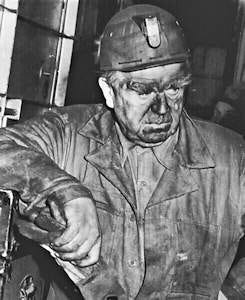
Even while opponents of the trusts were gleefully praising the Supreme Court of the Untied States as “the bulwark of freedom of trade,” the trusts caused Congress to enact a law which knocked over the main prop upon which the anti-trust forces had been depending in their war upon the great centralized corporations.
For more than a decade trust organizers had been confronted with a national law decreeing fine or imprisonment or both upon conviction for engaging in any act in restraint of trade. None had gone to prison, nor controlling the deciding functions of government, as they did, was there any prospect of the visitation of such a punishment. But the imprisonment clause was a constant irritant; why have it on the statute books when it could easily be obliterated? And why not also have a specific declaration of immunity? A solitary provision calling for fine in case of conviction, the magnates did not mind at all. It would give an appearance of deferring to public sentiment and, at the same time, could be lightly regarded by those at whom it was directed. When trust magnates were gathering in immense sums from illicit acts, what did a fine of a few thousand dollars matter? It was too trivial to bother over. Besides, even if the fine, by some extraordinary possibility were made heavy, it could be assessed, in turn, upon the consumer.
COMPLETE IMMUNITY FOR THE MAGNATES
That annoying imprisonment clause, however, had to be thrown out of the laws, and it deviously was by an act passed by Congress in 1903. Concurrently, the same act reasserted and amplified the principle of granting immunity to trust officers. No matter how much or how often they violated the anti-trust laws, they were now absolutely secure from any possibility of prison sentence.
The Government might examine them with the greatest pretended inquisitiveness, and in the process draw out the most self-incriminating admissions, but this evidence as testimony could not, by the act of 1903, be used against them in the trial of any criminal proceeding. Not only was the individual exempted; the corporation itself was distinctly relieved from prosecution for any penalty or forfeiture.
The triumph of the trusts was now intrinsically complete.
Pages 590-591
(<<) IMMUNITY: I couldn’t find anything further about this 1903 law, but, alas, I’m a rank amateur. It seems to be part of the historical DNA which finds us never bringing criminal charges against corporate bigwigs.
(>>) IMMUNITY: The same legislative backhander is mentioned again at the end of the fourth large paragraph below:
CHAPTER XXIII MORGAN AT HIS ZENITH
By the end of the year 1902 J. Pierpont Morgan, reckoning by appearances, seemed to outrank every other American magnate; scarcely a day passed that the newspapers did not report some new achievement of his, or obsequiously render tribute to his ever-expanding power. In the public appraisement he bulked as a supervitally preponderant man, a figure standing out with an immense and peculiar distinction, eclipsing the most obtrusive political and industrial functionaries.
Contrasted with him, ostensible political rulers were innocuous ephemeral personages. For a time they might vociferously command attention, but their encumbency was dependent upon the will of the magnates, and they were pushed up or pulled down as suited the policy and purposes of the great propertied interests. A long array of ‘‘eminent statesmen’* had shuffled into solemn view, and for a while had been the cynosure of the nation, and then, like exploded rockets, had disappeared into obscurity, or into a state akin to it. Yet, in another aspect, brief and borrowed as was their power, theirs was not the portion of oblivion; conventional history, which accepts the apparent as the real, documents and often perpetuates their names, ignorant of the fact that they were only the servers or servitors of particular impelling forces and interests.
Behind the nominal political masters stood the real masters—the great magnates.
HISTORICAL OMISSIONS AND MISJUDGMENTS
Seeing that this was so, what vitally boots it whether this or that individual happened to fill the so-called great elective or appointive offices? In stereotyped historical textbooks and narratives the names of J. Pierpont Morgan and his like do not enter; not even a cursory glimpse is given of their deeds. Yet, in large part, these are the significant things that fundamentally made economic history. If history tells the tale aright it will tell how President Theodore Roosevelt begged campaign funds from the very trust magnates whom he pretended to flout; how in a critical moment in the national election of 1904, he so despaired of success that he was forced to appeal lo Morgan, Harriman and their fellow magnates for a fresh and immediate infusion of funds.
The irresistible progress of the trust movement and the all-comprehending power of the magnates, can be better estimated when it is recalled that it was during Theodore Roosevelt’s administration that the most antagonistic campaign thus far essayed against the trusts was carried on. At least it seemed so If invective and suits at law counted. But, at basis, Theodore Roosevelt, despite his pretenses, was pliable to the purposes of the trust magnates, which fact was connoted anew by the circumstance that he was the President who signed the act striking out the imprisonment clause from the anti-rebating act assuring magnates and corporations full IMMUNITY from criminal prosecution.
It was proved again during the great coal strike of 1902 when Roosevelt was forced to beseech J. Pierpont Morgan to consent to some kind of arbitration settlement. True, indeed, Theodore Roosevelt, or those inspired by him, could darkly intimate that it were well for the coal magnates to come to terms; otherwise they might suffer criminal prosecution for violation of the act forbidding railroads from owning coal mines. But the magnates, well realizing how often they had heard this clap-trap sort of talk, and how empty and futile it all was, could pass it over with amused contempt. Then came the sight of the President of the United States, theoretically representing 85,000,000 of people, being compelled to parley and treat with a few magnates on their own terms. ‘‘The one man who controlled the operators,” wrote A. Maurice Low (who, unquestionably, was one of the best-informed newspaper correspondents at Washington), “was Mr. J. Pierpont Morgan. Everything else having failed, his services had to be enlisted.” Morgan instantly showed that he had the power of doing what the President of the United States acknowledged that the highest executive in the country in his own person could not do—a fact moving Low to exclaim reverentially (as quoted heretofore) : “Great is Mr. Morgan’s power, greater in some respects even than that of Presidents or Kings.” Theodore Roosevelt could publicly boast of his having settled that strike, yet, in point of actual fact, Morgan shrewdly used him to bring about a settlement at the time when the magnates decided it was politic, and with a result the most favorable that they could hope for in the particular alarming exigency.
Morgan’s lofty, surmounting status at this time did not arise from any misconception that he was the richest man in the United States. That prepotency John D. Rockefeller could easily claim and hold. But Morgan was so unceasingly before the public in some activity or other, and was so preeminently conspicuous in the organization of railroad combinations and industrial trusts, that, considering all aspects, he was looked upon as perhaps the most important of the magnates.
This was a popular deception, and was caused by the difference in tactics between Morgan and the Standard Oil oligarchy. The Rockefellers and their associates systematically discouraged publicity as to their business transactions; in all of their operations they cultivated the pro- foundest secrecy and took exceeding pains not to acquaint the people with the real extent of their possessions, nor with the methods by which they were gradually drawing into their ownership the resources of not only one nation, but of many nations. Working through auxiliaries or intermediaries they were converting much of the United States with its assets, including human labor, into their private property, but so surreptitiously was this done that they allowed no mention of their conquests to be either formally or informally given out. The Standard Oil headquarters was an inaccessible citadel of silence.
On the other hand, Morgan seemed to glory in the ostentation of publicity. Even if he did not, it was an indispensable requisite. In his threefold capacity of banker, railroad magnate and industrial trust organizer Morgan needed a certain amount of inspired publicity for the specific purposes of his undertakings. As a banker he had to advertise his financing of projects in order to dispose of the stock; the more power he was credited with, the more extraordinary a financier he was extolled, the easier it was to induce a multitude of investors to put their money in enterprises sponsored by him.
Pages 592-594
(>>) The next two paragraphs are fun just for the verbiage, albeit a great sorrow for the citizen:
“He is unquestionably,” went on Moody, “the boldest, the ablest and most far-seeing of any of the modern ‘generals of finance’ who stand at the head of the modern movement for the consolidation idea in the production and distribution of wealth. This is easily proven by the fact that the enterprises in which his influence is paramount today are the strongest and most ably planned of any of the great combinations or ‘trusts.’ ” ^
Such eulogies as this had a mechanical ring; they were manufactured almost automatically. That they passed unchallenged is sufficient comment upon the standards of the day, exemplified by the press as an institution for influencing the people. Even the dullest critic could observe how lacking in reservations and elucidations they were. No explanation was vouchsafed of the quality of Morgan’s “greatest,” nor any reason given why he should be brevetted a “general of finance.” The assumption evidently was fixed that these high-sounding, all-inclusive, prejudicative assertions would be swallowed as truth ordained; and, remarkable as it does seem, this has been the brand of truck ladled out for consumption by the American people.
MORGAN’S ORGANIZATION OF THE STEEL TRUST
What was the exceptionally strong and ably-planned Trust to which Moody thus so airily refers? It was the great Steel Trust. Need it be remarked that this was by no means Morgan’s only such progeny? In the organization of so many trusts did he participate that the term “Morganization of Industry” ran rampant like an obsession. With these other trusts, however, it is hardly necessary to deal; as a crystalline example of Morgan’s methods, the Steel Trust will doubtless suffice.
This trust, let it be proclaimed at the outset, was no paltry affair of a few hundred million dollars. It was an enterprise worthy of the application of a “great general of finance.” The pen may stumble in writing it, but somehow we will contrive to get the fact into print that this trust came into being with more than a billion dollars capital. And we feel irresistibly constrained to linger upon that billion dollars. The ordinary human mind is capable of much; it can let its exuberant imagination create heavens and hells, enchantments and exorcisms, and it can stretch illusion to realms without limit; but to conceive of a billion dollars, or rather to visualize it, is a task to be forsworn. Contemplating that billion dollars further, we are driven to note the immense progressions occurring in the case of a “great general of finance.” As a downy young man, Morgan was probably content with his profits of thousands in financing the selling of that batch of condemned rifles to the army; but then he was only a mere ambitious fledgling. Yet now, namely, in the year 1901, when he organized the Steel Trust, he had become a full- fledged “general,” and no “general of finance” in those days was worthy of the name unless he splashed in projects of the major hundreds of millions, or billions of dollars.
Pages 595-596
(<<) This was the first use of the word “billion” in the book – a word we are now numb to!
A TRUST PERFECT IN ALL PARTS
Apart from the recital of these frauds, there can be no gainsaying of the fact that the Steel Trust was the very acme of efficient organization for capitalist purposes. Other trusts might be well organized in the field of production, and partially that of distribution, and yet lack control of the supply of raw material. The Steel Trust controlled all three of these factors. It had its own plants. The railroad and steamship lines of the United States were at its disposal. It owned vast deposits of iron ore and coal, some of which had been turned over to it by Carnegie, and others of which John D. Rockefeller held. The Steel Trust, in fact, was the first trust to establish a scientific control over these three factors, so indispensable to the perfect operation of a trust. By its ownership of great iron deposits, and its practical dictatorship over transportation systems, it at once reduced nearly all of such competitors as it had to nonentities. Only one competitor, the Tennessee Coal and Iron Company, owned its own raw supply; and this competitor was later put out of the way under circumstances which will be described further on.
And here, again, enters the familiar factor of the small frauds being ousted by the great; of the property originally wrested by fraud being taken over by great magnates whose specialty (and it was a very serviceable specialty) was the extermination of lesser frauds. The original seizure of the mineral lands, particularly the iron ore mines in the Northwest, had been accomplished by force and by grossest frauds.
Pages 601-602
THE EXTENSIVE RAMIFICATIONS OF CORRUPTION
So long as the people had the delusion, and the capitalists the legislative votes, what good boded it to the magnates to have the secret come out? Over and over again was that secret disclosed in past investigations, but without instructive results. Yet, behold the people once more had the opportunity of getting an insight into what went on behind the scenes when the Legislative Investigating Committee reported in 1906:
The testimony taken by the committee makes it clear that the large insurance companies systematically attempted (sic) to control legislation in this [New York] and other States which could affect their interests directly or indirectly. The three companies divided the country, outside of New York and a few other States, so as to avoid a waste of effort, each looking after its chosen district and bearing its appropriate part of the total expenses.
Excellent! even bribery, like industry, became systematized and modernized. In the process, delicate externals were preserved. To ledger bribery funds as corruption money was a gross shock to fastidious taste, and was inexcusably unbusinesslike. Hence, so the committee reported, bribery expenditures were classified as “legal expenses.” The committee described them as extraordinarily large. The Mutual, in 1904, disbursed $364,254; the Equitable, $172,698, and the New York, with Morgan’s partner, Perkins, practically in command, $204,019. This, according to the simple rules of arithmetic, made a total of more than three-quarters of a million dollars spent in one year in the corrupting of legislatures, administrative officials and certain newspaper writers These “legal expenses,” the committee redundantly wrote, were “far in excess of the amounts required for legitimate purposes.”
For what were these corruption funds employed? To get laws under which great frauds could be carried on, and to prevent the passage of laws interfering with the graft. And who were the immediate distributors of the funds? Trained, circumspect lobbyists, thoroughly experienced in the business of knowing who, when and where to bribe …
But the corruption neither began nor ended with the buying of legislative votes or of administrative connivance. Over and above the politicians in office were the bosses in control of the machinery of both the Republican and the Democratic parties. Those party machines could command the votes; and the orders of the men at the head called for submission by the underling politicians. Refusal brought discipline and retirement. By controlling the secret workings of the party organizations, the magnates virtually controlled the platforms of those parties, their nominees, and the general course of the men elected to office.
For one more proof of this, another dip into the report of that celebrated insurance investigating committee of 1905 will suffice. “The insurance companies,” it reported, “regularly contributed large sums to the campaign funds of both the Republican and the Democratic parties.” This was no exceptional act, however; it was the conventional order of the day; all of the great corporations did likewise. Had not Jay Gould, thirty-odd years before, explained the method? And had not other capitalists long antecedent to Jay Gould shown how efficacious it was? A present of nearly $50,000 was contributed in 1894 by the New York Life Insurance Company to the campaign fund of the Republican National Committee, and similar amounts in 1896 and in 1900 for the same purpose. All of the large insurance companies gave contributions, not only for national political campaigns, but also for those in the States. It was found impossible to trace all of the directions of this continuous corruption. “Enormous sums,” the committee stated, “have been expended in a surreptitious manner.”
The immense sums thus spent in political corruption were taken from the proceeds of the policy holders. With this money, mounting into millions of dollars, the magnates bought their way into every State legislature in the Union; they purchased a way for themselves or for their allies into the United States Senate; and they carried their demands in both the Republican and the Democratic parties. An arraignment more destructive to the existing arrangement of society could not be found than was contained in the facts (and they were by no means, all of the facts) reported by that committee. The substantial conclusion was, although not set forth in so many plain words, that the administrative officials, the legislatures. Congress, the courts and the old political parties were controlled and dominated by groups of unparalleled frauds and pirates. For the sums diverted to insure this political control were only a tithe of the aggregate stupendous thefts. Following close upon the investigation came suits against the “high financiers” for the restitution of more than $10,000,000, and these suits were but indications of still vaster sums fraudulently taken. The suits were compromised.
Pages 609-611
(<<) (corrupting the legislatures)
(>>) (reluctance to jail the magnates)
DARK DAYS FOR RESPECTABILITY
It was a period of travail for respectability; much explaining had to be done, which (in such a case) was always a confession. The directors or swayers of those insurance companies comprised some of the most super-eminent magnates and exalted philanthropists in the United States. Elegant society suffered no shock at the revelations, for it was built and sustained, every part and woof of it, by theft, fraud, bribery and exploitation.
But the apologists and retainers, whose vocation it was to strew praise in the path of the money monarchs, were egregiously put out of face. What could they say when such of their heroes as Jacob H. Schiff, Henry C. Frick, D. O. Mills, and many others were being shown up either as participants or as responsible heads? More galling still was the besmearing of their great idols, E. H. Harriman, and above all, the devout and philanthropic J. Pierpont Morgan. All of these money conquerors had been interminably glorified; nothing had been too extravagant to say of them; and now they could be seen twisting and squirming in the uncomfortable act “of being caught.”
Good repute may be, as the poets and philosophers say, a priceless possession. But these magnates did not mind the temporary hurt. For temporary it surely was; a little time would pass, and then the newspapers, magazines, college presidents and clergy, largely owned or subsidized by the magnates, would resume their interrupted chorus of praise, and all would be well again. A bit of the plunder thrown out to universities and churches would add to the magical effect.
Hence, it was not any loss of reputation that the magnates and their satraps feared. The one and only disquieting prospect was that of being shunted away to prisons. Throughout the United States the insurance disclosures—the outcropping facts as to the vast, long-continuing corruptions and frauds—had called forth a frenzied demand at first that the guilty be rushed to trial and imprisoned.
But that demand, if carried out, would have entailed a unique and unprecedented situation. Should all of the guilty be jailed, or even a number of them, the nation would have been deprived of many of its foremost magnates, its greatest philanthropists, its most exemplary patriots. How could society have survived such a loss? According to orthodox teachings, these men were imperative to the proper administration, and the well being, of the whole social and industrial system. Incarcerate the great magnates, philanthropists and patriots, even though they were also the greatest plunderers? The thought was impossible.
No fear of prison, however, need have been entertained by the implicated. Had not many an investigation been held before, decade after decade, almost year after year, sometimes several investigations in a single year? Had any of the rich culprits disclosed in those investigations ever gone to prison? What ground was there for supposing that this investigation would result any differently? In a society ruled by money, what were courts for but to be used as a minatory instrument for enforcing the law, made by the rich, against the propertyless? What were judges for except to construe that law as the magnates who put them on the bench demanded that it be construed?
Not the law so much as the interpretation is what essentially counted.
THE MAGNATES ESCAPE THE LAW
How the law was interpreted was soon seen. Under the pressure of public opinion, District Attorney Jerome of New York County finally caused the Grand Jury to take action in proceeding against a few of the satraps and the figureheads. But, in the case of Perkins, for instance, it was decided that if he had committed grand larceny, it had been done without criminal intent. The thousands of poor offenders hurried off to prison were obviously afflicted with an overabundance of this same criminal intent. Yet for a rich and powerful man to commit any fraud with criminal intent was a principle unknown to practical jurisprudence. The farce dragged out a while; not one of the participants of great wealth was even incommoded by the formality of a trial.
(skip one paragraph)
Enough, however, of the methods by which these vast insurance funds were manipulated for politico-financial ends. The sensation caused by the revelations was as profound as the reaction that followed. For a brief period the masses were privileged to have a look behind the scenes, get wrought up at what they saw, and then the curtains were drawn again and the old comedy was resumed. The intense popular excitement flattened out into the sheerest lassitude.
What noteworthy changes resulted from all that protracted boring, ten solid volumes of it? None. Some lawyer folk grasped political advancement out of it, others enriched themselves from a trail of litigation, a few minor laws were passed, and one set of capitalists was deposed to make place for another. And that was the finis of this great investigation which was to have brought such “'beneficial reforms.”
Pages 611-614
(>>) (again, the smaller crooks whine about the magnates, but disdain the lower class)
But what of those virtuous speculative investors who, when tricked and defrauded by the magnates, plaintively put themselves on exhibition as outraged and helpless victims of a crew of unscrupulous financiers? How, for example, did many investors in Steel Trust stock regard the great Morgan after their disillusioning and spoliation? They broke out in passionate imprecations. Throughout the country you met them everywhere bewailing their losses; some of their thousands, others of their tens of thousands, and still others of their hundreds of thousands of dollars. In many another Wall Street onslaught, the losers could not specifically blame Morgan; but in the Steel Trust stock-rigging he was so palpably the principal moving spirit, that necessarily this bitterness was directed at him. To the point of nausea the charge was repeated that fraud had brought about the stripping or ruin of those innocent, confiding investors; fraud did it all, fraud explained the whole process.
Delicious innocence! Not an individual was there among those self- commiserating investors who would not have been elated to have profited in the stock market at the expense of other investors. Had such been the outcome, the transaction would have been highly legitimate and just. The crime consisted in the magnates exclusively pocketing the booty. This at once transformed the operation into one of betrayal, injustice, fraud and oppression. Then came that old familiarly dolorous plaint of grievances. And would the terrors of law never descend upon the supersubtle corporate greed that was swindling and devouring the virtuous middle class, “the backbone of the country”?
THE SOURCE OF PROFITS
Agitated over their own misfortunes and expropriation, these investors excoriated Morgan and the other magnates. And their actuating reason was what? That of not being allowed to have a hand in the profits. Who has not heard pigs squeal when a hog usurps the trough! And what, further, were the basic conditions from which these investors eagerly strained for profits, either in stock gambling or in dividends?
The value of the stock depended at bottom upon the trade profits of the business. Those profits came from the labor in the mills and the exploitation of the manufactured product. Were the petty investors, so clamorous for their own security and comfort, uneasy at the conditions under which masses of men and boys worked in the iron and coal mines and in the steel manufacturing plants? Did they experience any qualms at the long hours and low pay, and the squalid, often revolting, life to which those workers were forced? Did the bestial degradation and frightful destitution so often encountered in steel-mill quarters disturb their thoughts? Or were they impressed by the ghastly casualties in the mills, or the diseases rife in the workingmen’s quarters, causing an undiminished slaughter of men, women and children? Did the investors, whose understanding of injustice was so sensitively acute when they were robbed or in distress, see any injustice in such conditions?
In this exploitation they saw nothing but a “righteous” system of industry from which they eagerly sought profit. They were not ignorant of the existence of these conditions; it was with a knowledge, not always full, but some realization, nevertheless, of them, that they sophisticatedly bought Steel Trust stock to share in the profits. When an exposure was made, in 1908, of some of these conditions, not more than a handful of stockholders protested against the horrors; exceptions to which we gladly draw attention.
To describe those conditions at length would be an inappropriate anticipation of another part of this work to which the description is more germane. Some glimpses, however, will be to the point. Nor will the facts be drawn from working-class spokesmen and writers. Do not the conventions of the day condemn these as unworthy of credence and citation? Observe with what immense respect legislatures, Congress, the courts, editors and literary reviewers treat the trashiest utterances of capitalists, and swear by their value and authenticity. But working-class memorials, protests and statements are obviously the productions of “rabid agitators”; they “chronically exaggerate” and are “partial and partisan.” Since capitalists (and their retinue of scribes) alone possess the high virtue of complete veracity, citations from such sources will perhaps carry weight.
Pages 615-617
CHAPTER XXIV
MORGAN AS ''THE SAVIOR OF THE NATION”
All previous panegyrics lavished upon Morgan became stale and inadequate compared to the apotheosis of him during the panic of 1907. What climax of earthly splendor did Morgan reach? He became the "Savior of the Nation.”
Around their genesis, methods and characters, the magnates wove romantic yarns. They supplied the inspiration; a host of writers and orators, trained to transfer that romancing into catchwords and phrases, carried it to the people and popularized it until it became an almost adamantine tradition. Always it was the same species of romance; the toil, the thrift, the integrity, the wonderful ability by which the magnates reaped their fortunes; their heroism in time of war, their saving philanthropy in all great crises.
The audacity of these "literary” puffers was as great as the imposture of the magnates whom they covered with adulation. In the very commission of vast frauds and avaricious transactions, the magnates posed as public-spirited, patriotic men. Their puffers hastened to paint them likewise. There was no judicious waiting until time had receded, and the actual facts were more or less forgotten. The very enormities of the magnates were at once transformed into acts of the greatest purity, and the people were called upon to applaud. In every conceivable manner the press, or at least a considerable section of it, was manipulated to counteract the effect of disclosures.
Page 619
THE STEEL TRUST ABSORBS A DANGEROUS COMPETITOR
The Tennessee Coal and Iron Company was the most dangerous competitor of the Steel Trust. It was the one great competitor having its own sources of iron ore and coal supply. In the fall of 1907 it owned, it was estimated, from 500,000,000 to 700,000,000 tons of iron ore, 2,000,000,- 000 tons of coal, and “very large quantities of flux and fluxing material.” All of these coal deposits were within a radius of thirty miles of its plant in Birmingham, Ala. The owners of this company were planning improvements which would have made it an even more serious competitor of the Steel Trust, and they had plans under way of merging the Republic Steel Company with their corporation. Moreover, the Tennessee Coal and Iron Company was foremost in the development of the open hearth system of making steel rails. Its rails were in greater demand, and brought higher prices, than those of the Steel Trust.
In the difficult financial position of the Trust Company of America, the Morgan interests saw their great opportunity of eliminating the competition of the Tennessee Coal and Iron Company. To prevent itself going into bankruptcy, the Trust Company of America needed large and immediate amounts of cash, which was scarce. Morgan and his clique had the cash. The condition insisted upon by Morgan was that the company should sell him the stock of the Tennessee Coal and Iron Company that it was holding as collateral for loans. Hard pressed, the Trust Company of America had to yield, and sell the stock at the low price offered. The next move was to make the Tennessee Coal and Iron Company a part of the Steel Trust.
There was, however, an obstacle. The Federal anti-trust law prohibited such combinations. How could this situation be overcome? President Theodore Roosevelt was incessantly and gustily threatening the great magnates with the enforcement of this law. But apparently Morgan knew Roosevelt much better than the country knew him. He undoubtedly reckoned that Roosevelt’s talk was mere words, and that Roosevelt would prove his subservience anew in acts.
The report went that Morgan, through emissaries sent to the White House, informed Roosevelt that unless the merger of the two steel companies was allowed by the Government, the Trust Company of America would go down in failure, causing a train of other bankruptcies, and the panic would be intensified manifold. Whatever were the reasons for Roosevelt’s submission, he gave his consent. At that very time the courts were enforcing the anti-trust law with a construction that no one had dreamed of when the law was passed. The eminent judges discovered that labor unions were trusts, and issued writs against them on the ground that they were conspiracies in defiance of that law! Roosevelt was bitterly denounced; his action, however, mattered little so far as the merging of the two corporations was concerned; had not the Steel Trust obtained control at that particular time it would have inevitably done so at some other time, and by another process. According to disclosures before the Senate Committee on Judiciary, the Steel Trust made a profit of $670,000,000 by forcing the Trust Company of America to sell the control of the enormously valuable plants and mines of the Tennessee Coal & Iron Company at a preposterously low price.
Where did Morgan and his associates get the money with which to carry on the process of terrorizing the country and gathering in immense industrial and other properties? Again, the people had another of those frequently occurring vivid opportunities of seeing how thoroughly the United States Government was an instrument of the capitalists. In the banks there were hundreds of millions of Government money. The few oligarchs controlling the great banks were allowed to use this money as though it were their private property. They declined to loan any money to anyone until their plans were ready, and when they did loan, it was at extortionate rates of interest. Even this complete transference of Government funds did not satisfy them; they demanded more. The Government at once responded. Cortelyou, Secretary of the Treasury, instantly permitted the national banks to issue $30,000,000 more in paper currency, and made the mints work night and day to turn out fresh coin.
Posing as the savior of the country, Morgan came forward at the auspicious time, on the afternoon, of October 24, 1907, and magnanimously announced his desire to ‘‘relieve the tension. Excepting the very few magnates thus engineering the whole situation, there was a general clamor for loans of money. The loans were finally given on that afternoon. The “savior of the country” demanded from 20 per cent, upwards for loans, and exacted securities as collateral at heavy sacrifices to the borrowers. The money that he thus loaned was Government money, squeezed in taxation from the producers. It was a classic example of Government of, for and by the great capitalists.
Pages 625-627
(<<) “savior of the nation,” my lumpy ass …
(>>) CAUTION, SARCASM:
In scrutinizing Morgan’s career, one prodigious virtue is encountered. It is that of consistency. The quality of his patriotism and heroism never changed from the time of his introduction into business. That rifle sale at the outbreak of the Civil War was the first exhibition of his intense patriotism. In 1894 his patriotic nature was again displayed consistently when he and his clique squeezed a profit of $18,000,000 or more from the Government in a time of need. In the panic of 1907 his never-failing patriotism was even more prominently shown.
While the effusions of the “popular writers” were wending the rounds of the country, a recalcitrant United States Senator was boring the august Senate of the United States with a long, tiresome speech. The bulk of the august Senate did not care to hear what this Senator, one La Follette, of Wisconsin, had to say, but were compelled to by the rules. The Senate of the United States was most sensitively jealous of its prestige and dignity. Most of its members at that time were multimillionaires. La Follette lacked that highly important qualification. Still more, he was painfully deficient in caste in another respect. He had not bought his way into the Senate of the United States, thereby outraging one of its most sacred canons. Hence he could give no real test of standing or any guarantee of wise, conservative statemanship.
But the majority of his colleagues had good reason to be impatient of La Follette’s speech. His was a voice from the past. They represented the newer order, that of centralized industry, and a Government run directly by the magnates themselves. He was a relic of the old creed, that of the age of competition in industry.
For four long days, March 17, 19, 24 and 29, 1908, he delivered his lugubrious wail. “In their strife for more money, more power—more power, more money,’’ he explained in describing the great magnates, “there is no time for thought, for reflection. Government, society and the individual are swallowed up in the struggle for greater control.” Thus he stumbled through mazes of facts the purport and interpretation of which he did not understand. Neither did he comprehend the fundamental fact that commercial upheavals are not the work of individuals, but of the whole capitalist system; that certain powerful individuals or interests could accelerate or retard them, but could not be held responsible for their causation. According to him, a crowd of conspirators, headed by the Standard Oil Company and Morgan had deliberately brought on the panic; he fulminated against them and denounced them as arch criminals.
Amid his accusations, lamentations and platitudes Senator La Follette embodied certain facts of real historic value—facts confirmed by the records of what actually took place, and familiar to all close observers of events during the panic.
The panic of 1907, like previous panics, supplied the propitious opportunity to the great magnates to crush out lesser magnates and seize the control of their property.
Pages 620-621 (out of sequence)
Before organizing the Ice Trust, Morse had been an inconspicuous banker. In the course of this business he had dealings in discounting the notes of various individuals and firms engaged in the selling of ice. Conceiving the idea of forming a trust in that necessity, he set about to crush out the small dealers. One of his first steps was to assure himself of the collusion of powerful politicians ruling the government of New York City.
In its investigation of the administration of New York City, the ‘‘Mazet Committee”—an investigating body appointed by the Legislature in 1899—exposed the conspiracy between the Ice Trust, on the one hand, and, on the other, the Dock and other municipal departments, to create and maintain a monopoly of New York’s ice supply. Mayor Van Wyck, a puppet of the big Tammany leaders, subsequently admitted in his testimony, before Judge Gaynor, of the New York Supreme Court, that he had obtained five thousand shares, worth $500,000, of Ice Trust stock. He alleged that he had paid $57,000 in cash for them. Pressed for proof to substantiate his statement, he failed to prove that he had actually paid anything. The testimony before the “Mazet Committee” conclusively showed that the corrupt arrangement between the Ice Trust and the city officials was such as to compel the people to pay sixty cents a hundred pounds, and that the Ice Trust had stopped the sale of five-cent pieces of ice, practically cutting off the supply of the very poor.
With its assured monopoly, the Ice Trust declined to make the slightest concession.
MILLIONS FROM SUFFERING, DISEASE AND DEATH
The result was a noticeably great increase in the rate of mortality among the children of the poor. Large numbers of families, living on the most precarious edge of destitution, could not afford to pay the extra five cents demanded for a piece of ice. The milk soured and acted like poison on the children. The increasing number of deaths in successive summers when the terrific heat made ice an absolute necessity, especially in the congested tenements, could be traced, in large part, to the methods of the Ice Trust. Millions of other people who could ill afford to pay the exactions demanded were compelled to give up extra tribute or go without ice.
Those methods were not any different from those of capitalism in every field. The invariable principle upon which capitalists acted, and by which they tremendously augmented their profits, was to sell necessities at the very highest price when the people needed them most. In the depths of winter the price of coal was always raised to an exorbitant point. While giving his bits of donations for the founding of hospitals, the successful capitalist reaped his millions from conditions productive of vast suffering and disease on every hand.
The more profits that he made, the more of a financial genius he was accounted by his class, and by all who were influenced by the standards of that class. As soon as Morse proved that he could exact immense profits, he was hailed as a foremost and very successful capitalist. The newspapers began giving extended notices of him, the price of Ice Trust stock went up in Wall street, and fine men and women in elegant society were only too eager to get hold of stock paying such rich dividends. True, charges of violating the law were made against Morse and his associates, but those charges were not based upon any concern for the mass of people, nor upon any indignation at the privations, suffering and deaths caused by the methods of the Ice Trust; they were made solely on behalf of the smaller firms whom Morse had forced out of business. District Attorney Jerome could discover no criminality in any of Morse’s methods, and caused criminal proceedings brought against the Ice Trust officials to be dismissed.
Pages 622-623
(>>) This next section is contiguous, but rather than the small magnates preying upon the poor folk, it describes the grand magnates crushing the lesser swindlers. The expressions “pecking order” and “greasy pole” come to mind.
From this process of exaction and indirect homicide on a great scale, the Ice Trust’s profits became very great. The money thus taken in, Morse used to finance other enterprises. Buying up the control of a number of coastwise steamship lines, he consolidated them into one corporation, with the familiar accompaniments of stock watering and juggling. He allied himself with the Heinzes who owned large copper mines in Montana, and whose manipulation of the politics and politicians of that State was somewhat similar to that Morse used in New York City. Also, he made a coalition with Thomas, who controlled some New York banks.
On the surface this seemed a very powerful combination; not an opportunity was lost by Morse and his associates to spread abroad the impression that they were too formidable to be overthrown.
THE GREAT MAGNATES LIE IN AMBUSH
These men made much noise in the financial world, and dashed around with prodigious belief in their invincibility. They were vaunted as great financiers; doubtless inflated by their own success, they esteemed themselves so, and judged themselves fully able to cope with the great magnates. In the meantime, the Morgan and Rockefeller group was carefully observing their operations, and awaiting the ripe time when they could be crushed out at one blow. The Standard Oil Company wanted those copper mines, and the steamship company organized by Morse was considered a competitive menace to railroad lines controlled by the Morgan and Rockefeller interests.
Senator La Toilette’s account of events that followed was accurate as to the facts. In his speech in the United States Senate he gave this narrative:
(I skip an overlong detailed account of how the Morgans and their ilk manipulated the markets and eliminated Morse and his associates)
In a day, as it were, the Morse-Heinze-Thomas group was smashed into nothingness, and its properties seized. If the experience of those venturesome little magnates had ended there, they would have had cause to rejoice over their good fortune. But their rout had to be made complete. The Federal authorities began to take a sudden interest in their operations. Where previously the Government's prosecuting officials had been wholly unaware that Morse, Heinze and Thomas had been committing fraud in their financial methods, they now spied out the fullest evidences. From certain quarters proofs were offered of violations of the law by the fallen trio. The United States District Attorney’s office in New York City became alive with energy. It caused grand jurors to investigate, and showed striking official zeal in the prosecution. Heinze was indicted, and Morse brought to trial, convicted, and sentenced to fifteen years in prison—a verdict from which he appealed. The United States Circuit Court of Appeals affirmed the verdict. After serving some years in the Federal prison at Atlanta, Morse was released.
Morse and Heinze learned two valuable lessons which all aspiring little magnates could well take to heart: First, that it was extremely unwise to cross the interests of the really big magnates; and, second, that those magnates could use the criminal machinery of the courts against opponents of their own class, not less than against labor leaders, labor unions and the propertiless in general.
Pages 623-625
NO AID FOR THE UNEMPLOYED
While the Government was placing the treasury of the United States at the disposal of Morgan, what was it doing for the millions of workers thrown into enforced idleness and destitution? By June, 1908, it was conservatively estimated that perhaps five million workers in the United States were out of work, and could get none. Reports from the charity organizations in every city showed that the cities were overcrowded with the homeless and unemployed. Destitution was rife, and cases of starvation of men, women and children, were more frequent than the official reports dared reveal. The jails throughout the country were crowded with men who, thrown out of work, were adjudged vagrants and sentenced. Many of the homeless voluntarily committed some breach of the law in order to be sent to jail. There, at least, shelter and food could be obtained. Many towns adopted the plan of deliberately driving out the unemployed. Everywhere crime increased; driven to absolute necessity, many workers stole, and, of course, were dispatched to prison. The Social Ethical League, of New York City, reported that crime had increased fifty i>er cent, within six months.
With destitution and starvation everywhere, what did the Government, whether National, State, or city, do for the unemployed? Nothing except to club and terrorize them when they presumed to hold street meetings to plead for the right to work.
In the whole sphere of government there was not a single real representative of the workers to speak or act for the workers. The Government was a Government elected largely by the votes of millions of workingmen, yet the working class did not have a single mouthpiece in that Government. A Senator such as Davis of Arkansas might rise, as he did, in the United States Senate on December 12, 1907, and fiercely denounce ‘The stock gamblers and thieves of Wall street,” but, he, and all like him, did not speak for the working class, about which they cared nothing save to keep it in submission; they spoke for the middle class and for that alone.
Pages 627-628
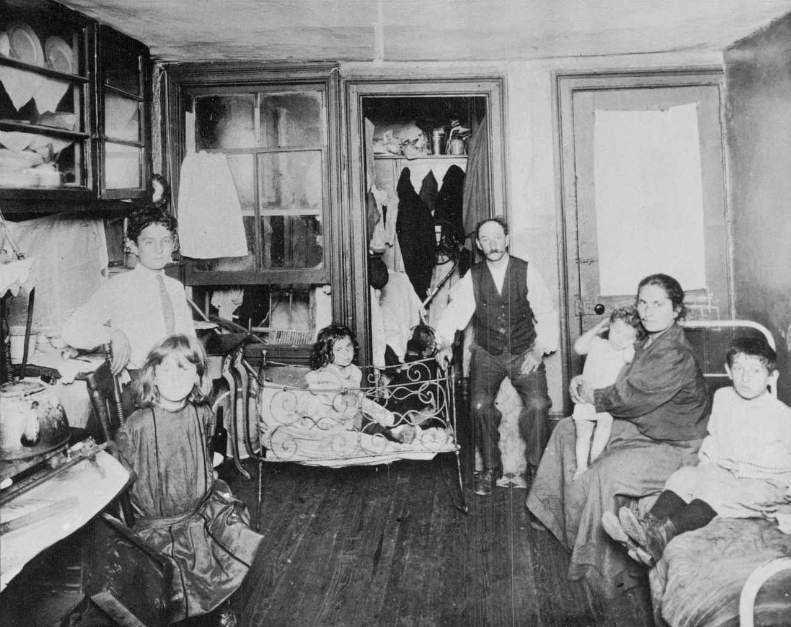
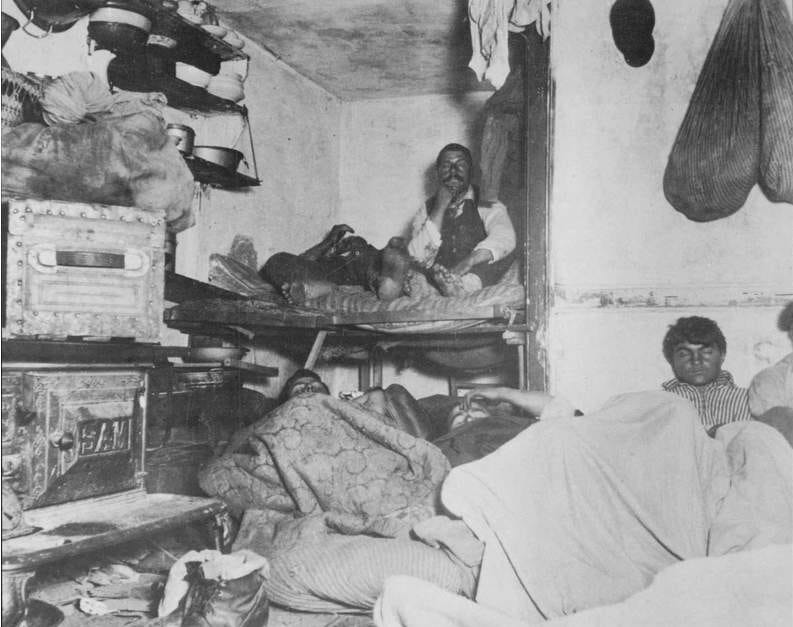
MORGAN’S DEATH AND THE FLOOD OF EULOGIES
It was at Rome, Italy, that Morgan died of exhaustion on March 31, 1913. To the hotel there, where he had occupied a suite of two parlors and eight sleeping rooms costing $500 a day, came a flood of messages of condolence. Among them was one from King Victor Emanuel of Italy, and another from Pope Pius X who described Morgan as “a great and good man.”
In London the Evening Standard hailed his power as wielding “an influence in England no less potent than in America;” the Pall Mall Gazette described him as “a towering constructive force in the finance of two nations and a generous benefactor in many other fields;” Lord Avebury, Chairman of the London Bankers acclaimed Morgan as “a genius and we bankers are proud of him;” and Alfred De Rothschild, a brother of Lord Rothschild, said: “It is impossible in a few words to do justice to this giant in finance, a man equally great in everything connected with science and art, with an ever generous heart for all those who came in contact with him.”
Pages 634-635
(<<) Beloved by the Rothschilds – in other words, a cancerous demon.
(Arnie: That’s it for me, folks!)
(The book continues with a not-long section about Morgan’s son, following in Daddy’s footsteps, then two short chapters on the Elkins’ fortune and the Hill fortune, then a short epilog. The epilog mentions some other big name money grabbers ─ people you would know ─ and Gustavus points out that writing about them would require more large volumes, and he's leaving that to others. Such a project would most notably involve the Rockefeller saga.)
THANK YOU FOR STOPPING BY AND FEEL FREE TO WRITE ME AT: